
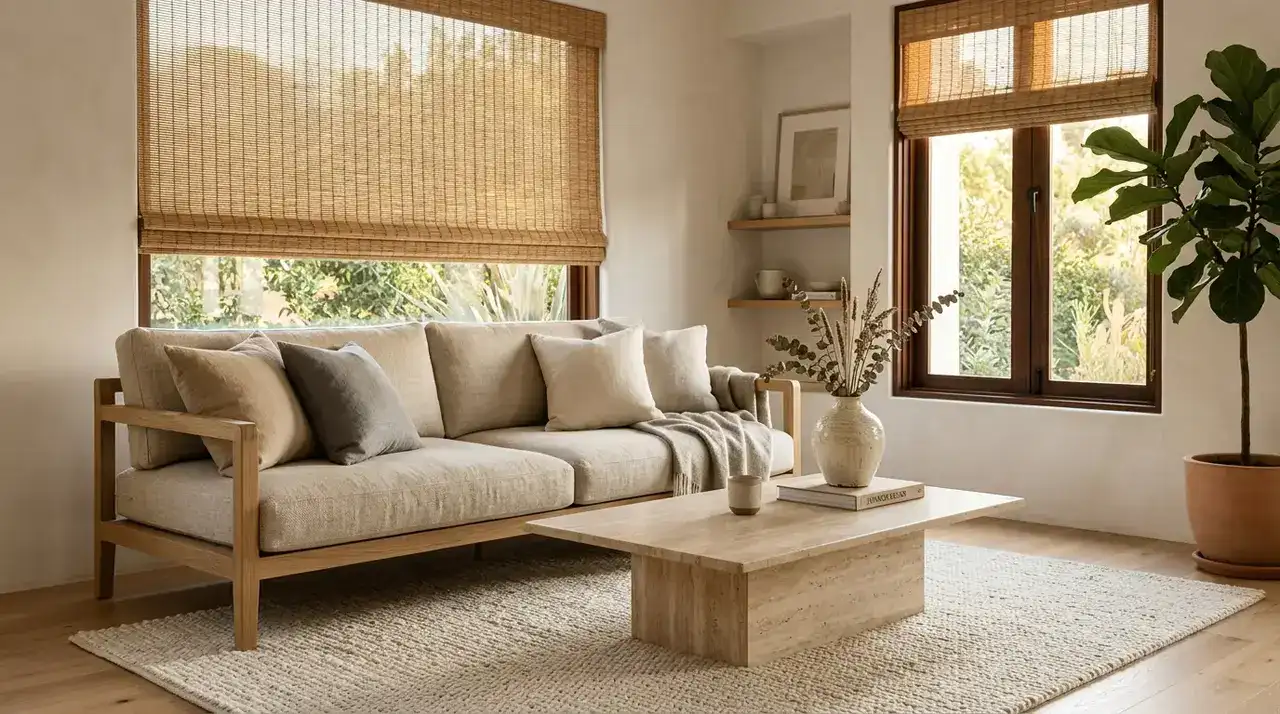

The living room carries more of the Japandi identity than any other room in the house — it’s where the low-profile furniture, the natural materials, and the negative space all have to work together at once. Here are fifteen ways to build that balance without it tipping into either sparse or generic.
A luxury Japandi living room centers on a low, solid-wood-framed sofa in linen or boucle, a natural stone coffee table, layered warm lighting, and a small number of artisan-made accent pieces — with negative space treated as a design element rather than empty room left to fill later.
Table of Contents
1. Anchor the Room With a Low-Profile Oak Sofa
Japandi sofas sit lower than a typical Western sofa, with exposed or partially exposed solid oak legs and frames. The lower seat height opens up sightlines across the room and echoes the floor-level furniture common in Japanese interiors. Look for kiln-dried oak or ash frames — they resist warping far better than softwood alternatives.
2. Choose a Travertine or Honed Marble Coffee Table
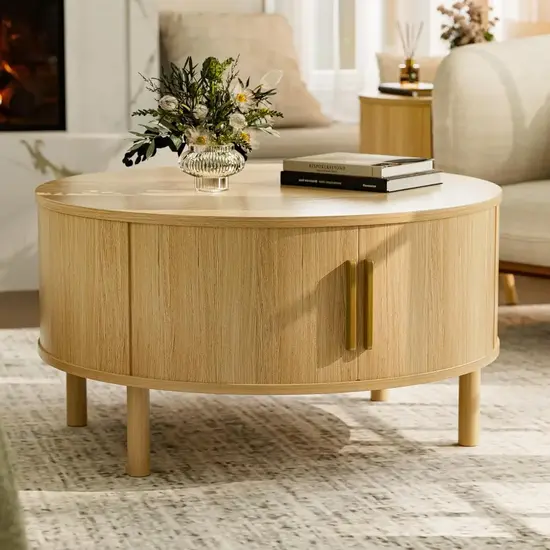
A single slab or two-piece travertine coffee table does more visual work than any accessory in the room. Keep the finish honed rather than polished, and let the natural pitting in the stone stay visible rather than filled — that texture is the entire point.
3. Let Linen Curtains Do the Light Work
Heavy blackout drapery has no place here. Unlined or lightly lined linen curtains in oatmeal or undyed tones filter daylight into something soft and diffuse, which is a big part of why Japandi rooms photograph so calmly at any hour.
4. Build a Low Media Console, Not a Media Wall
Where possible, treat the television as something to walk past rather than face directly. A long, low walnut console with woven rattan cabinet fronts keeps electronics out of view and adds warmth without competing with the sofa.
5. Introduce One Genuine Artisan Ceramic Piece
A single hand-thrown stoneware vase or bowl, ideally with visible throwing marks or a matte glaze that varies slightly across its surface, reads as considered in a way that a shelf of matching decor never will.
6. Layer Three Light Sources at Different Heights
A floor lamp with a paper or linen shade, a low table lamp, and one dimmable overhead source (or none at all, if the room gets good natural light) gives the room depth after dark instead of the flat wash of a single ceiling fixture.
7. Use a Wool or Jute Area Rug to Ground the Furniture
A flatweave wool or jute rug in a warm neutral defines the seating area without introducing pattern. Avoid high-pile rugs — they read as cozy-Scandi rather than Japandi.
8. Add a Single Statement Chair, Not a Matching Pair
One well-made lounge chair — leather sling, rattan frame, or bent-oak — placed at an angle to the sofa breaks the symmetry of a room in a way that feels intentional rather than incomplete.
9. Bring in Black Steel or Bronze as the Contrast Metal
Matte black steel window frames, a bronze picture ledge, or blackened-steel shelf brackets give the warm wood tones something to push against. Skip polished chrome and brushed nickel — both are too cool and too shiny for this palette.
10. Keep Wall Art to One or Two Pieces, Framed Simply
A single large-scale abstract or 3D textured wall art in a thin oak or black frame outperforms a curated gallery wall in a Japandi room. The empty wall space around it is doing as much visual work as the art itself.
11. Choose a Plaster or Limewash Accent Wall
One wall — usually behind the sofa or media console — finished in lime plaster or limewash paint gives the room its signature handmade texture without the cost of plastering the entire space.
12. Use Woven Rattan or Bamboo Blinds Where Curtains Aren’t Practical
In rooms with a lot of direct sun, a natural rattan or bamboo roller blind under the linen curtains adds texture and controls glare without introducing anything synthetic.
13. Style the Coffee Table With Restraint
Two objects, maximum three: a ceramic bowl, a stack of two or three books, and perhaps a single stem in a small vase. Anything more starts to look staged rather than lived-in.
14. Bring in Greenery That Reads as Sculptural
A single fiddle-leaf fig, olive tree, or dried pampas branch in a stoneware planter does more for the room than a cluster of small potted plants. Choose plants with strong, simple silhouettes.
15. Leave One Corner Genuinely Empty
This is the hardest instruction for most people to follow. A deliberately empty corner — no plant, no chair, no shelf — is what separates a Japandi room from a “neutral decor” room. The eye needs somewhere to rest.
| Element | Material to Use | Material to Avoid |
|---|---|---|
| Sofa frame | Solid oak, ash | Painted MDF, particleboard |
| Coffee table | Honed travertine, marble, solid wood | Glass, glossy laminate |
| Rug | Wool flatweave, jute | Synthetic shag |
| Metal accents | Blackened steel, bronze | Chrome, brushed nickel |
Key Takeaways
- Anchor the room with a low, solid-wood sofa and a honed natural stone coffee table.
- Layer three light sources rather than relying on one overhead fixture.
- Choose one artisan ceramic piece over a shelf of matching decor.
- Blackened steel and bronze are the right contrast metals; skip chrome and nickel.
- Leave at least one corner of the room genuinely empty.
Suggest Reads
- Japandi Interior Design: The Complete Luxury Guide (2026)
- Japandi Bedroom Design: A Serene Luxury Retreat Guide
- Japandi Kitchen Design: Minimalist Luxury for the Home Chef
- Japandi Bathroom Design: Spa-Like Serenity at Home
- Japandi Dining Room Ideas for a Warm, Refined Home
- What Is Japandi Style? Wabi-Sabi & Hygge Design Guide
Frequently Asked Questions
What color should a Japandi living room sofa be?
Undyed or naturally dyed linen tones — oatmeal, sand, and soft greige — work best, with charcoal boucle as the main darker alternative.
Can a Japandi living room have a fireplace?
Yes, especially a plaster-clad or stone-clad fireplace, which fits the material palette naturally. A glossy marble surround or ornate mantel works against the style.
Is it okay to mix wood tones in a Japandi living room?
A primary pale wood (oak or ash) with one secondary darker wood (walnut) for contrast works well. Mixing more than two distinct wood tones starts to look unplanned.
What size rug works best under a Japandi sofa?
Large enough that at least the front legs of every seating piece rest on it — undersized rugs are one of the fastest ways to make a considered room look unfinished.
How do I add coziness without breaking the Japandi look?
Textural layering — a boucle throw, a linen cushion, a sheepskin on a wood chair — adds warmth without introducing pattern or clutter.