

Infinity pools are redefining luxury residential design in 2026 — and the numbers behind them are more compelling than ever.
Whether you’re a homeowner weighing a six-figure backyard investment, a designer specifying premium finishes, or a real estate investor calculating resale returns, the data tells a clear story: vanishing edge pools deliver unmatched aesthetic impact and measurable financial upside in the right markets.
This guide compiles 15+ verified statistics on installation costs by region, annual maintenance spending, smart technology adoption rates, and property value impact — everything you need to make a fully informed decision, backed by the latest industry research and 2026 market data.
Table of Contents
Top 5 Infinity Pool Statistics for 2026
- The global swimming pool market is valued at $10.89 billion in 2026 and is projected to reach $44.03 billion by 2035 at an 8.6% CAGR.
- Infinity pool installation costs range from $60,000 to $150,000 on average — approximately 20–25% more than a standard in-ground pool.
- In Sun Belt states, a luxury pool can increase home value by 7–10%; coastal markets see ROI of 60–70% of total construction cost.
- The smart pool systems market is forecast to grow from $1.5 billion (2024) to $3.5 billion by 2033, driven by automation and IoT integration.
- Vacation rental properties with luxury pools command 20–40% higher nightly rates than comparable homes without them in markets like Florida.
What Is an Infinity Pool?
An infinity pool — also called a vanishing edge pool, zero edge pool, negative edge pool, or knife edge pool — is a swimming pool designed with one or more edges flush with the water level.
Water flows continuously over the edge into a hidden catch basin, where it is filtered and recirculated back into the pool. The result is a breathtaking optical illusion: the pool appears to merge seamlessly with the surrounding landscape, sky, or ocean.
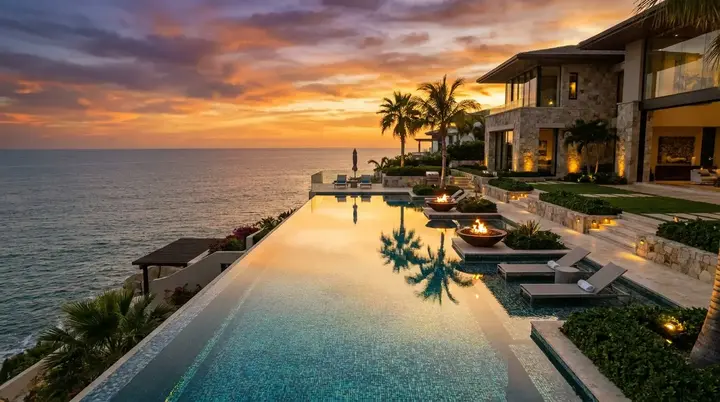
A vanishing edge infinity pool design creates the illusion of water meeting the horizon — the defining feature of this luxury pool category. Replace with high-res photography.
Originally popularized at luxury resorts in Bali and the Mediterranean, the style has migrated aggressively into high-end residential construction.
Hillside lots, waterfront properties, and elevated terraces are the most natural fit — but modern structural engineering now allows the design on nearly any property where a level grade can be created artificially.
Unlike conventional pools, infinity designs require a second structural shell (the catch basin) and a more powerful recirculation system, which is why they cost more to build and maintain than standard in-ground pools.
Top 15 Infinity Pool Statistics for 2026
Market Size & Growth
| $10.89B Global swimming pool market value in 2026 Business Research Insights, 2026 | 9.5% CAGR of the smart pool systems market through 2033 Verified Market Reports, 2025 |
| 8.6% Projected CAGR of the global pool market through 2035 Business Research Insights, 2026 | $44B Projected pool market value by 2035 Business Research Insights, 2026 |
The pool industry as a whole is experiencing robust expansion, fueled by rising wellness culture, remote-work-driven home investment, and the premiumization of outdoor living spaces. Infinity pools sit at the apex of this trend — they are the single most recognizable marker of resort-caliber residential design.
The Los Angeles pool construction market, a bellwether for luxury trends nationally, is projected to grow at 5.3% annually through 2028, with customization, smart features, and infinity edges leading new-build specifications.
Average Installation Costs by Region
| Region / State | Standard In-Ground Pool | Infinity Pool Estimate |
|---|---|---|
| National Average | $65,000–$87,000 | $80,000–$130,000 |
| California | $59,000–$140,000 | $100,000–$180,000+ |
| Texas | $52,000–$101,000 | $75,000–$140,000 |
| Florida (Luxury) | $50,000–$100,000 | $150,000–$300,000+ |
| Northeast | $70,000–$100,000 | $90,000–$160,000 |
Sources: Angi 2026, HomeGuide 2025, Celebrity Pool & Spa 2026. Costs reflect base installation; full project budgets typically run 30–50% higher after decking, landscaping, permits, and equipment.
🌴Luxury resort-style infinity pool with stone copingAlt: Resort-style infinity pool design with natural stone decking
Premium materials like glass tile and natural stone are hallmarks of high-end infinity pool design, with tile pools alone costing $75,000–$150,000.
ROI & Property Value Impact
“In Orange County’s warm-weather, high-end market, a well-designed pool is often an expected amenity — and infinity edges are how top-tier properties signal luxury.”
ROI data on infinity pools follows a clear geographic pattern. Warm, coastal, and high-net-worth markets deliver the strongest returns; colder and suburban markets are more modest but still positive.
Florida coastal (luxury) 60–70%
Southern California coast 60–70%
Sun Belt (AZ, TX, NV) 50–56%
Inland / suburban 40–50%
Northern / colder states 5–20%
ROI expressed as percentage of total construction cost recouped at sale. Source: Signature Landscape, HFS Financial, Angi, 2026.
Most Popular Design Features
Based on 2026 industry data, the following features are driving new infinity pool specifications:
- Infinity/vanishing edge: The defining design element — standard for all luxury builds
- Glass tile finish: Dominant in high-end markets; $75,000–$150,000 range
- Integrated spa: Combined pool-spa designs maximizing ROI per square foot
- Smart automation: 55% of new LA pool installations include at least one automated system
- LED lighting: Standard upgrade across all price tiers; preferred over halogens for energy savings
- Salt chlorination: Reduces annual chemical costs from $300–$800 down to $70–$100
- Tanning ledges & outdoor kitchen integration: Resort-style amenities now expected in luxury segments
Infinity Pool Cost Breakdown (Data-Driven)
Building an infinity pool is one of the most engineering-intensive backyard projects. Here is every cost category you need to budget for in 2026.
1 Material Selection
Material is the single largest variable in your quote. Fiberglass ($25,000–$50,000) offers low maintenance and quick installation.
Vinyl liner ($20,000–$60,000) is most affordable but least durable. Concrete/gunite ($65,000–$120,000) allows maximum customization.
Glass tile ($75,000–$150,000) is the premium choice for luxury infinity designs — beautiful but slow to install and requires more maintenance to prevent algae.
2 Labor & Engineering
Labor accounts for 25–50% of total project cost, or $50–$240 per square foot, depending on site conditions and the complexity of the vanishing edge structure.
A pre-construction geotechnical soil report runs $1,000–$5,000. The catch basin and secondary recirculation system add meaningful engineering overhead versus a standard pool.
3 Excavation & Site Prep
Excavating the pool hole costs $1,000–$5,000. If your site has rocky soil or requires significant grading, expect additional charges. Retaining walls — common on hillside infinity pool sites — run $35–$65 per square foot installed.
4 Permits & Insurance
Swimming pool permits cost $500–$2,000 depending on municipality. Some regions require additional zoning fees of $475–$1,900. Expect your homeowner’s insurance premium to rise by $200–$500 per year after installation.
5 Premium Add-Ons
Heating, smart automation, and LED lighting packages typically add 10–20% to the base project cost. A pool house ranges from $100–$600 per square foot. Pool fencing runs $15–$30 per linear foot. A dedicated pool deck adds significant cost but is strongly recommended for resale appeal.
Materials & Construction
| Material | Installation Cost | Durability | Notes |
|---|---|---|---|
| Fiberglass | $25,000–$50,000 | High | Pre-formed shell; fastest install; $5K–$10K maintenance/decade |
| Vinyl Liner | $20,000–$60,000 | Low–Med | Budget-friendly but prone to tearing; less common for luxury builds |
| Concrete / Gunite | $65,000–$120,000 | Very High | Most versatile; 12+ week install; resurfacing every 10–15 years |
| Glass Tile | $75,000–$150,000 | High | Premier luxury finish; complete color customization; algae-prone |
Maintenance Costs Annually
Key stat: Infinity pools typically cost $2,000–$4,035 per year in professional maintenance — at the high end of the pool category due to their dual-basin recirculation system and complex filtration requirements. Monthly professional service runs $80–$150.
Annual ownership costs to model in your budget:
- Chemicals & filters: $1,000–$4,000/year (standard chlorine) or $70–$100/year (salt chlorination)
- Electricity (pump & heater): $300–$1,200/year; variable-speed smart pumps cut this by up to 85%
- Concrete resurfacing: $8,000–$10,000 every 10–15 years
- Insurance increase: $200–$500/year additional premium
- Property tax increase: Modest but real; amount varies by municipality
Premium Add-Ons: Heating, Lighting & Automation
💡LED-lit infinity pool at night with smart automation panelAlt: Infinity pool design with smart LED lighting and automation controls
Smart automation systems allow pool owners to control temperature, lighting, and filtration from a smartphone — now a standard expectation in the luxury segment.
Adding smart automation, heating, and premium lighting is strongly recommended for both lifestyle value and resale performance. In 2026 luxury markets, pools without automation systems are increasingly viewed as dated — even relatively new ones.
| Add-On | Cost Range | Benefit |
|---|---|---|
| Smart automation system | $2,000–$15,000 | Remote control of all pool functions; reduces maintenance labor |
| Pool heater | $1,500–$5,000 | Extends swim season; required in northern markets |
| LED color lighting | $700–$2,500 | Dramatic nighttime aesthetics; lowers energy vs. halogen |
| Salt chlorination | $1,500–$2,500 | Reduces annual chemical cost from $800 to ~$100 |
| Robotic pool cleaner | $500–$2,000 | Eliminates daily manual skimming; pairs with smart systems |
| Pool fence | $15–$30/linear ft | Safety, code compliance, insurance requirement |
Infinity Pool Design Trends Dominating 2026
Smart Pool Technology Integration
| 55% New LA pool builds that include at least one smart automation feature Cabaña on the Chain, 2026 | $3.5B Projected smart pool systems market by 2033 (from $1.5B in 2024) Verified Market Reports, 2025 | 40% Of all pools expected to be smart-enabled by 2030 PoolCalculator.net, 2026 |
Smart pool technology is the fastest-growing segment of the pool industry. Buyers in 2026 expect to control pool temperature, filtration, and lighting from a smartphone.
Systems capable of automated cleaning, AI-driven water chemistry monitoring, and real-time leak detection are now standard luxury specifications rather than premium upgrades.
The financial case is compelling: smart systems reduce pool maintenance costs by up to 30%, with automated variable-speed pumps slashing energy consumption by up to 85% compared to older single-speed models. Early adopters report utility bill reductions of 30–50% after installing full automation packages.
Sustainable & Eco-Friendly Designs
Sustainability has moved from a niche preference to a mainstream buying criterion. In 2026, eco-conscious design features in new infinity pool builds include:
☀️ Solar heating integration
Solar pool heaters offset gas costs and qualify for energy rebates. Solar integration is surging by an estimated 25% year-over-year in new builds.
🔬 Salt water systems
Saltwater chlorination produces gentler water and cuts chemical usage dramatically — from $800/year down to roughly $100/year in running costs.
⚡ Variable-speed pumps
Now a standard energy code requirement in many states. VSPs reduce pump energy use by up to 85% and qualify for utility rebates of up to $600.
💧 Smart leak detection
AI-powered sensors detect sub-millimeter water level changes and alert owners before losses become costly — protecting both water bills and pool structure.
Resort-Style Backyard Transformations
Resort-style backyard with infinity pool and outdoor kitchenAlt: Resort-style infinity pool design with integrated spa and outdoor entertaining area
The 2026 luxury backyard integrates infinity pool, spa, tanning ledge, outdoor kitchen, and smart automation into a unified resort-style experience.
The most pronounced shift in 2026 is the “whole backyard as resort” philosophy. Infinity pools are increasingly conceived as the visual centerpiece of a larger outdoor living ecosystem — paired with integrated spas, tanning ledges, outdoor kitchens, fire features, and landscaped entertainment zones.
This holistic approach delivers stronger ROI than the pool alone: customized outdoor living spaces increase property value by approximately 7–15% in markets where buyers expect them, turning the backyard transformation into a genuine financial strategy rather than pure lifestyle spending.
Infinity Pool ROI: Do They Increase Home Value?
Luxury Real Estate Data
The short answer is yes — but the degree varies substantially by location, property tier, and build quality. Here is what the 2026 data shows:
In Southern California, a pool can increase a home’s value by 5–8%. For a median-priced Orange County home at approximately $1.3 million in early 2026, that translates to $65,000–$104,000 in added value.
In Florida’s premium markets — Naples, Palm Beach, Coral Gables — luxury infinity pools have added $75,000 to $200,000 in appraised home value, with some ultra-premium properties seeing even greater returns when pool design is architecturally cohesive with the home.
Florida’s income-generating short-term rental market provides an additional ROI layer: vacation rental properties with private luxury pools command 20–40% higher nightly rates than comparable homes without them.
The Newport Beach benchmark is illustrative: a custom gunite pool with infinity edge, integrated spa, and glass tile finish at $185,000 significantly boosted the home’s appraised value before sale — representing a strong return in a coastal market where buyers treat a resort-caliber pool as an expected amenity.
The 2026 appreciation estimates by specific market:
| Market | Estimated Home Value Increase |
|---|---|
| Laguna Beach, CA | +4.5% |
| Huntington Beach, CA | +4.2% |
| Newport Beach, CA | +3.8% |
| Mission Viejo, CA | +3.5% |
| Naples / Palm Beach, FL | +5–8% (luxury tier) |
| Sun Belt states (AZ, TX) | +7–10%+ |
| Northern / midwestern states | +2–5% |
Buyer Preference Statistics
The structural shift toward outdoor living, accelerated by remote work adoption, has made pools a more powerful buying signal than at any point in the prior decade.
Pool valuation has shifted: appraisers who once treated pools as a modest add-on now give them meaningful weight in warm-weather markets.
Key buyer preference findings for 2026:
- In Southern California, Florida, and Arizona, homes without pools can sit on the market longer or sell at a discount relative to comparable pool homes
- Smart automation and energy-efficient equipment rank among the top buyer-decision features — pools without them are increasingly perceived as dated
- A modern gunite pool with premium finishes consistently outperforms older pools or vinyl liner builds in both buyer appeal and final sale price
- Overbuilding pool luxury relative to neighborhood norms produces a pool homeowners enjoy but buyers won’t pay proportionally for — matching to market comp is essential
Luxury home with infinity pool increasing curb appealAlt: Luxury home exterior featuring infinity pool design and premium landscaping
In premium coastal and Sun Belt markets, a resort-caliber infinity pool is increasingly expected by buyers — making it both a lifestyle amenity and a competitive listing asset.
Conclusion
Infinity pools in 2026 are no longer a niche luxury reserved for hillside estates and five-star resorts. A global swimming pool market heading toward $44 billion, rising outdoor living expectations, and the remote-work-driven demand for home-as-resort have made vanishing edge design a mainstream ambition for high-end homeowners across the Sun Belt and beyond.
The numbers are clear: installation costs range from $60,000 to $150,000+ depending on material, region, and features; annual maintenance runs $2,000–$4,000; and in the right market, a well-executed infinity pool returns 60–70% of construction cost at sale while adding 5–10% to appraised home value.
Smart automation — now present in 55% of new Los Angeles pool installations — is the single most impactful upgrade for both daily convenience and long-term buyer appeal.The most important takeaway: ROI is geographic. Coastal and Sun Belt buyers expect and reward luxury pools.
Northern and suburban markets require more careful analysis. Wherever you build, matching pool quality and budget to your market’s comparable properties is the foundation of a sound investment.
FAQ About Infinity Pool Statistics
How much does a 12×24 infinity pool cost?
Typically $60,000–$75,000 for the base install. With decking, heating, and automation, the all-in budget usually reaches $90,000–$110,000+.
What is the downside of an infinity pool?
Higher cost (20–25% more), complex engineering, steeper maintenance ($4,035/yr), site limitations, plus increased insurance and property taxes.
Do infinity pools add value to your home?
Yes — 5–10% in Sun Belt markets, 60–70% ROI on construction cost in coastal areas. Returns are lower (2–5%) in colder northern states.
How long does it take to build an infinity pool?
Most infinity pools take 12–20 weeks. Concrete builds run longest due to curing time. Fiberglass is fastest at 8–12 weeks.
Are infinity pools safe to swim in?
Yes. The vanishing edge is an optical illusion — a pool wall stops swimmers. With proper fencing and railings, they’re as safe as standard pools.
Do you need a view for an infinity pool?
Not always. A view enhances the effect, but skilled landscaping or an elevated deck can replicate the illusion on flat properties.
What is the best material for an infinity pool?
Glass tile offers the best luxury finish ($75K–$150K). Concrete balances durability and customization. Fiberglass is the most budget-friendly option.
Can I add an infinity edge to an existing pool?
It’s complex and costly. A full structural retrofit is usually required. Most experts recommend building a new infinity pool from scratch instead.
How much does infinity pool maintenance cost per month?
Expect $80–$150/month for professional service, plus chemicals. Smart automation can reduce total annual upkeep costs by up to 30%.
Does an infinity pool use more water than a regular pool?
Not significantly. Water flowing over the edge is captured in the catch basin and recirculated — very little is actually lost during normal operation.