
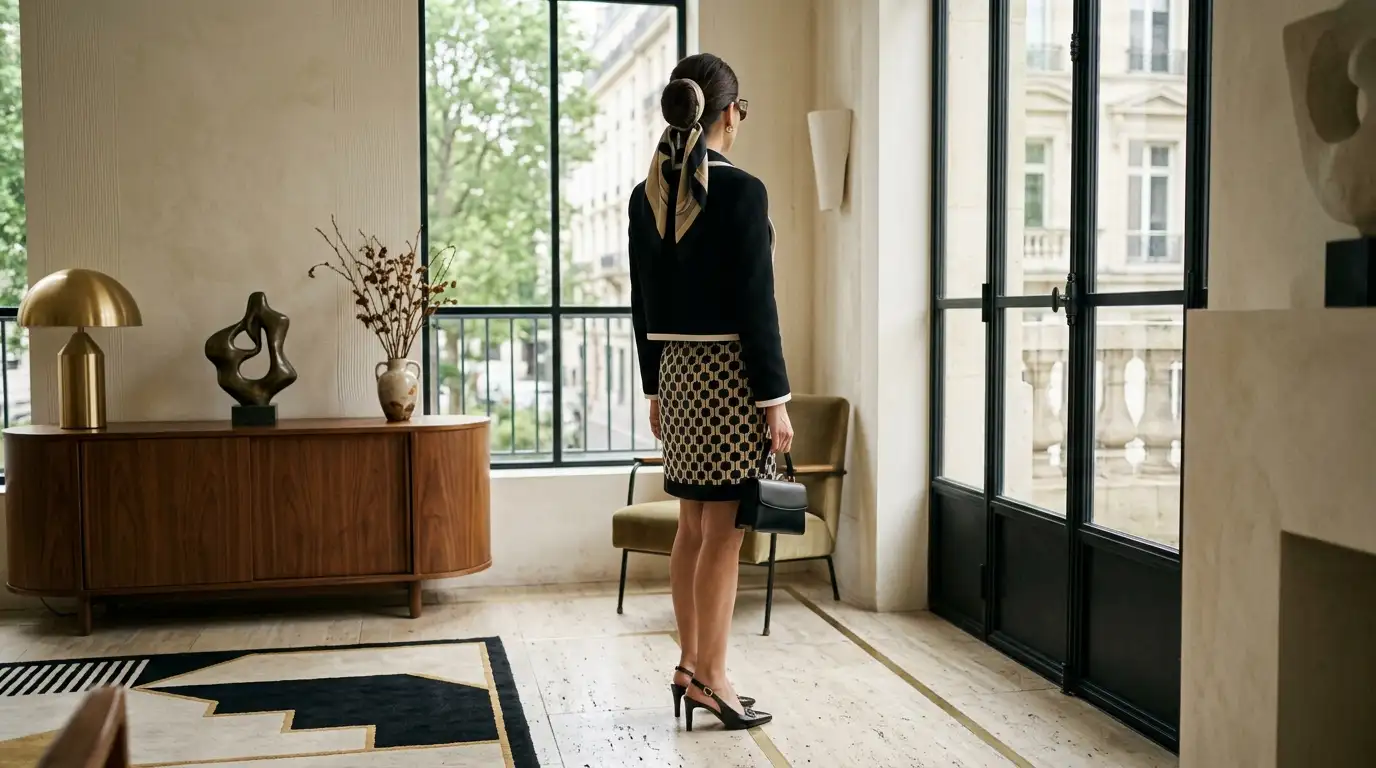

The 1960s changed the way women dressed. Elegant tailoring remained, yet fashion began moving toward shorter hemlines, sharper geometry, simpler silhouettes, and a new kind of freedom. Parisian couture houses such as Givenchy and Yves Saint Laurent helped shape the decade, while designers such as André Courrèges pushed fashion toward a futuristic, architectural look.
A polished 1960s wardrobe could be remarkably simple: a precise shift dress, a cropped jacket, polished slingbacks, oversized sunglasses, and a silk scarf. The beauty came from proportion, fabric, and cut.
This 1960s fashion style guide explores that transition from traditional couture to modernist dressing and shows how to bring the decade’s most refined ideas into a contemporary wardrobe.
Quick answer: The most recognizable elements of sophisticated 1960s women’s fashion include shift dresses, A-line skirts, geometric tailoring, cropped jackets, slim trousers, monochrome outfits, bold color blocking, oversized sunglasses, silk scarves, slingbacks, structured handbags, and clean-lined coats. The most luxurious interpretation relies on excellent fabric, precise proportions, and restrained accessories.
Table of Contents
The Evolution of 1960s Fashions for Women
The early 1960s still carried the polished elegance of the previous decade. Women wore fitted jackets, graceful dresses, gloves, tailored suits, and carefully coordinated accessories.
As the decade progressed, fashion became lighter, shorter, younger, and more experimental. The shift dress replaced some of the restrictive shaping of earlier silhouettes, while geometric cuts gave clothing a distinctly modern character.
Paris remained central to high fashion, but London and other cultural centers contributed their own energy. Youth culture, modern art, space exploration, new synthetic fabrics, and changing ideas about women’s lives all appeared in clothing.
From Haute Couture to Mod Minimalist Liberation
Early-1960s couture still favored craftsmanship and formal presentation. The traditional Parisian woman might wear a beautifully fitted dress with a structured jacket, elegant gloves, polished shoes, and a carefully shaped handbag.
Then the mood changed.
Designers began reducing clothing to cleaner shapes. The body could move more freely inside a shift dress or A-line silhouette. Shorter skirts exposed more of the leg, while flat boots and simple pumps created a sharper visual line.
André Courrèges became particularly associated with this futuristic direction. His designs used white, geometric forms, streamlined construction, and short silhouettes that suggested a vision of modern life.
Yves Saint Laurent brought another kind of modernity to women’s fashion. His work blurred traditional boundaries between masculine tailoring and feminine dressing, making pieces such as the trouser suit feel sophisticated and distinctly contemporary.
The luxury of the 1960s therefore became increasingly connected to precision rather than decoration.
A beautifully cut garment could make a stronger statement than a dress covered in embellishment.
Clean Lines & Architectural Cuts: The Shift from Structured to Fluid
The decade’s most influential silhouettes were easy to recognize from their outline.
The shift dress fell relatively straight from the shoulders. The A-line dress widened gently toward the hem. Short jackets created a compact upper body, while slim trousers gave outfits a long, clean finish.
These shapes worked particularly well with luxurious materials.
Silk, fine wool, jacquard, cashmere, leather, and quality cotton could give simple cuts a sophisticated presence. The garment did the visual work.
This approach is useful today because it makes vintage-inspired dressing feel polished rather than costume-like. Start with one strong shape, then allow the rest of the outfit to remain quiet.
Iconic 60s Fashion Trends & Style Icons
The 1960s produced several distinct fashion personalities.
Audrey Hepburn represented refined Parisian simplicity. Twiggy became associated with the youthful London mod aesthetic. Jackie Kennedy popularized polished American elegance, while Jane Birkin later became an enduring reference for relaxed French style.
These women had very different wardrobes, yet each demonstrated the power of a recognizable silhouette.
The Parisian Jet-Set Aesthetic: Audrey Hepburn & Hubert de Givenchy
Audrey Hepburn’s collaboration with Hubert de Givenchy created one of the most recognizable fashion partnerships of the twentieth century.
Givenchy’s designs for Hepburn often relied on simplicity: elegant black dresses, clean necklines, slim trousers, fitted coats, ballet flats, and carefully chosen accessories.
The appeal was restraint.
A black dress with a precise neckline and excellent fit could carry an entire look. Add a small handbag, oversized sunglasses, and a silk scarf and the outfit becomes unmistakably Parisian.
For a modern interpretation, consider:
- A black shift dress in wool crepe
- Slim ankle trousers
- A cropped blazer
- Leather ballet flats or slingbacks
- Oversized acetate sunglasses
- A small structured handbag
- A silk neck scarf
The secret is proportion. Keep the clothing simple and let one or two accessories create the character.
The Mod Revolution: Space-Age Tailoring & Color-Blocking
The mod movement brought a dramatically different energy.
Short dresses, graphic patterns, bold blocks of color, white boots, geometric jewelry, and clean tailoring became symbols of youthful modernism.
Courrèges pushed the space-age aesthetic further with white clothing, streamlined silhouettes, trousers, boots, and futuristic shapes. The result felt connected to the era’s fascination with technology and space exploration.
Color became an important design tool.
Instead of layering several decorative elements, designers could use black and white, red and pink, blue and white, or other strong combinations to create visual impact.
A sophisticated modern version might pair a cream shift dress with black slingbacks and a structured black handbag. For a stronger mod reference, choose a geometric dress and keep jewelry minimal.
The result should feel crisp.
High-Society Riviera Style: Jane Birkin and Effortless Resortwear
Riviera dressing offered another side of 1960s style.
Light dresses, woven accessories, striped tops, relaxed trousers, silk scarves, sunglasses, and simple sandals created a wardrobe suited to coastal travel.
Jane Birkin became associated with an effortless French style that continued influencing fashion long after the 1960s. Her appeal came partly from the contrast between simple clothing and an unmistakable personal attitude.
For an elevated resort wardrobe, try:
- A white cotton or linen dress
- A striped Breton-style top
- High-waisted cream trousers
- Leather sandals
- A silk scarf
- Oversized sunglasses
- A woven handbag
Keep the palette controlled. Ivory, navy, black, camel, tan, and soft blue create an elegant foundation.
Essential 1960s Dress Outfits & Shift Dress Silhouettes
The dress was one of the defining garments of 1960s women’s fashion.
Its shape changed dramatically during the decade. Earlier dresses could still emphasize the waist, while later designs often allowed the fabric to hang more freely from the shoulders.
That change made the dress feel younger and more modern.
The Modernist Shift Dress: Clean Geometry for Day-to-Night Wear
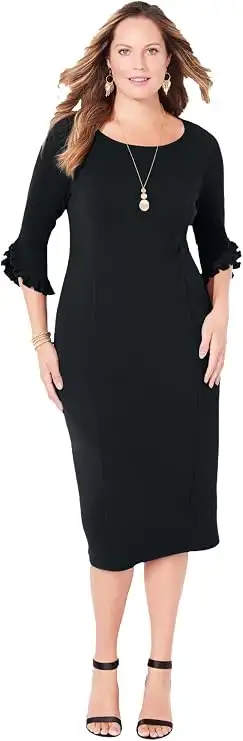
The shift dress remains one of the easiest 1960s silhouettes to wear today.
Its relatively straight shape creates a clean vertical line. A sleeveless version works beautifully during the day, while a silk or jacquard version can move into evening with the right accessories.
For daytime, pair a wool shift with slingbacks and a structured handbag.
For evening, choose silk, satin, jacquard, or velvet and add pointed shoes, sculptural earrings, and a compact clutch.
The strongest versions often use very little decoration.
Look for:
- Straight or gently relaxed construction
- Above-knee or knee-length hems
- Clean necklines
- Minimal seams
- Quality fabric
- Strong shoulder definition
- A controlled color palette
A black, ivory, navy, or jewel-toned shift can become one of the most versatile pieces in a wardrobe.
The Column Gown & A-Line Evening Dresses in Silk & Jacquard
Eveningwear retained its glamour during the decade, although the silhouette became increasingly streamlined.
The column gown created a long, elegant line through the body. The A-line evening dress offered more movement while maintaining a strong geometric shape.
Fabric made a major difference.
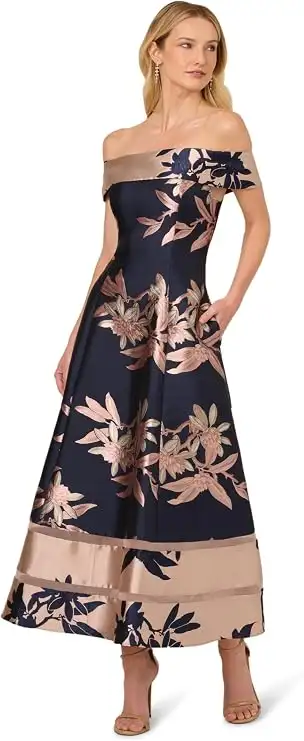
Silk gave a column dress a fluid surface, while jacquard could introduce pattern and texture without requiring excessive decoration.
For a contemporary evening interpretation, choose one exceptional fabric and let the silhouette carry the outfit.
A simple silk gown with sculptural earrings can feel more sophisticated than an outfit overloaded with jewelry, embellishment, and competing details.
Styling 60s Mini and Midi Lengths with Refined Elegance
The mini skirt became one of the decade’s defining fashion developments.
Yet the shorter hem does not have to create a playful or casual outfit. Pairing a mini dress with a beautifully cut coat, opaque tights, polished leather shoes, and restrained jewelry can give the look a distinctly refined character.
Midi lengths offer another option.
A knee-length or below-the-knee A-line dress can feel more conservative while retaining the clean geometry associated with 1960s fashion.
For balance, consider the complete silhouette rather than focusing on the hemline alone.
A short dress works particularly well with a longer coat. A midi dress can pair beautifully with a compact jacket and low-profile slingbacks.
Modernizing 60s Vintage Elegance for Daily Wear
The easiest way to wear 1960s fashion today is to borrow the decade’s design principles rather than recreate a complete period costume.
Choose one or two references.
A shift dress with contemporary leather shoes can suggest the decade. So can slim trousers, a cropped jacket, oversized sunglasses, and a silk scarf.
The goal is a wardrobe that feels connected to the era while still working for modern life.
Footwear Upgrades: Italian Leather Slingbacks, Go-Go Boots & Mules
Shoes can change the entire character of a 1960s-inspired outfit.
Slingbacks create a polished Parisian finish. Choose smooth leather, a moderate heel, and a pointed or softly rounded toe.
Go-go boots have a stronger mod association. White or cream leather creates the classic space-age effect, while black makes the look easier to integrate into a modern wardrobe.
Mules offer another route.
A minimalist leather mule can work with cropped trousers, an A-line skirt, or a simple shift dress.
For everyday luxury, pay attention to construction. Clean stitching, quality leather, a comfortable footbed, and a well-balanced heel will usually matter more than excessive ornamentation.
High-End Accessories: Oversized Acetate Frames, Pillbox Accents & Silk Scarves
Accessories provide an easy way to introduce 1960s references without changing your entire wardrobe.
Oversized sunglasses immediately create a retro mood. Choose thick acetate frames in black, tortoiseshell, cream, or dark brown.
Silk scarves offer more versatility.
Tie one around your neck, knot it onto a handbag, or wear it over the hair for a distinctly Parisian reference.
Pillbox hats are closely associated with the polished early-1960s look. For everyday wear, a small structured hat can provide the same visual idea without requiring a complete vintage ensemble.
Jewelry should follow the geometry of the clothing.
Think sculptural earrings, simple bangles, a bold watch, or a single statement ring.
Outerwear Icons: Double-Breasted Pea Coats and Vinyl Trench Coats
Outerwear was another major part of the decade’s visual identity.
The double-breasted coat provided classic structure, while shorter coats worked beautifully with mini dresses and A-line skirts.
For a refined wardrobe, look for wool, cashmere blends, or tightly woven fabrics in navy, camel, charcoal, ivory, or black.
Vinyl and glossy raincoats introduced a more futuristic side of the decade. A modern interpretation can use a subtle sheen rather than a highly theatrical finish.
The most wearable combination is often a clean coat over a simple dress.
The coat creates the architectural outline while the dress provides the softer interior silhouette.
How to Build a Modern 1960s-Inspired Wardrobe
You don’t need a closet full of vintage clothing to capture the decade.
Start with five foundations:
- A shift dress — preferably black, cream, navy, or another versatile shade.
- A cropped jacket — choose a precise shoulder and clean front.
- Slim ankle trousers — pair them with flats, slingbacks, or low heels.
- A structured handbag — choose leather with minimal hardware.
- A silk scarf — use it as a neck, hair, or handbag accessory.
Then add one statement piece.
That could be oversized sunglasses, white boots, a geometric dress, a jacquard coat, or a bold color-blocked top.
This approach keeps the wardrobe wearable while preserving the visual language of the 1960s.
The Best Fabrics for 1960s-Inspired Luxury
Fabric determines whether a simple 1960s silhouette feels inexpensive or sophisticated.
For dresses, consider wool crepe, silk, jacquard, cotton poplin, velvet, and fine knitwear.
For jackets and coats, look for wool, cashmere blends, textured bouclé, leather, or high-quality cotton.
The decade’s clean shapes make fabric quality especially visible. A simple shift dress has nowhere to hide poor construction.
Pay attention to drape, seams, lining, buttons, zippers, and the way the garment holds its shape.
A well-made minimalist piece can stay relevant for years.
1960s Fashion Colors Worth Wearing Today
The decade offered two very different color directions.
One was refined and restrained: black, ivory, camel, navy, chocolate brown, soft gray, and cream.
The other was graphic and youthful: bright red, orange, pink, cobalt, emerald, yellow, and stark white.
Both can work today.
For a quiet luxury wardrobe, build around neutrals and introduce one saturated color through a handbag, shoe, scarf, or dress.
For a stronger mod look, use two contrasting colors and keep the accessories simple.
Color blocking works best when the shapes remain clean.
Common Mistakes When Recreating 1960s Style
The easiest mistake is combining too many recognizable retro elements at once.
A mini dress, white go-go boots, oversized sunglasses, geometric earrings, a pillbox hat, and a bold graphic handbag can quickly become theatrical.
Instead, choose a focal point.
If the dress has a strong geometric print, use simple shoes and a quiet handbag.
If you’re wearing dramatic white boots, choose a restrained dress and coat.
If oversized sunglasses are the statement, keep the rest of the accessories polished and simple.
The strongest modern interpretation usually comes from editing the outfit carefully.
Key Takeaways
- The 1960s marked a major shift toward cleaner, shorter, more geometric women’s fashion.
- Givenchy’s work with Audrey Hepburn became a lasting reference for refined Parisian simplicity.
- Courrèges helped define the decade’s futuristic, space-age aesthetic.
- Yves Saint Laurent brought sophisticated tailoring and masculine-inspired elements into women’s wardrobes.
- The shift dress remains one of the easiest 1960s silhouettes to wear today.
- Silk, wool, jacquard, cashmere, and quality leather give minimalist designs a more luxurious finish.
- Oversized sunglasses, silk scarves, structured handbags, and slingbacks provide easy 1960s references.
- Modern styling works best when you select a few period details and combine them with contemporary pieces.
Suggested Reads: 1950s Fashion Style Guide: Timeless Elegance
Frequently Asked Questions About 1960s Fashion
What did women wear in the 1960s?
Women wore a wide range of styles during the decade, including tailored suits, shift dresses, A-line skirts, slim trousers, cropped jackets, blouses, coats, mini dresses, and elegant evening gowns. Fashion changed considerably between the early and late 1960s.
What was the most popular dress style in the 1960s?
The shift dress became one of the decade’s defining silhouettes. Its straight or gently relaxed shape reflected the move toward simpler, more geometric clothing.
How do you dress like a 1960s woman today?
Start with a modern shift dress, cropped jacket, slim trousers, slingbacks, oversized sunglasses, or a silk scarf. Choose one or two 1960s references rather than wearing every retro element together.
What designers influenced 1960s fashion?
Important designers associated with the decade include André Courrèges, Yves Saint Laurent, Hubert de Givenchy, Mary Quant, Pierre Cardin, and other designers working across Paris and London.
What shoes were popular in the 1960s?
Women wore pumps, slingbacks, ballet flats, ankle boots, go-go boots, sandals, and other low- to moderate-heeled shoes. Footwear varied according to the particular fashion movement and stage of the decade.
What colors were popular in 1960s fashion?
Black and white were particularly important to modernist and mod dressing, while bold shades such as red, orange, yellow, pink, blue, and green appeared in youthful fashion.
How can I wear 1960s fashion without looking like I’m wearing a costume?
Build a contemporary outfit around one strong 1960s reference. A shift dress with modern leather shoes, slim trousers with oversized sunglasses, or a cropped jacket with a silk scarf can suggest the decade while remaining current.
Is 1960s fashion still relevant?
Yes. Shift dresses, tailored trousers, geometric silhouettes, oversized eyewear, structured handbags, short coats, and minimalist color palettes continue to appear in contemporary wardrobes. Their simple shapes make them particularly easy to reinterpret.