

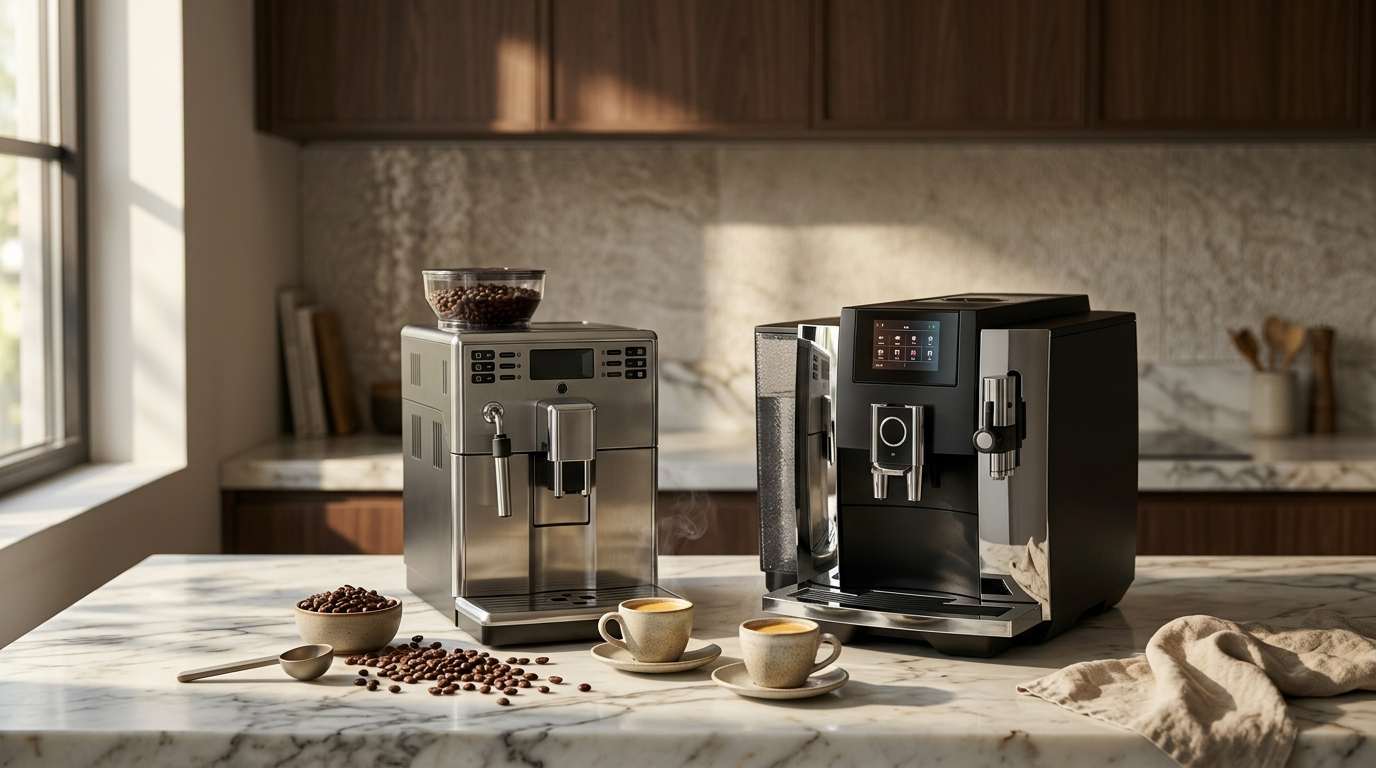

A good espresso machine should make excellent coffee. A great super-automatic espresso machine should do much more: grind whole beans, dose the coffee, brew the espresso, and handle milk drinks with minimal effort. For anyone who wants café-style coffee without learning the techniques required by a traditional espresso setup, super-automatic machines remain one of the most convenient options in 2026.
We have compared the most interesting machines across different price levels, focusing on espresso quality, grinder performance, milk preparation, customization, cleaning, reliability, convenience, and overall value. The goal is not simply to identify the machine with the longest feature list. Instead, we want to determine which machines make the most sense for different coffee drinkers.
Among the models worth considering are the Gaggia Brera, Gaggia Anima, and Jura Z10, along with several alternatives that approach automatic coffee preparation in different ways. Some prioritize simplicity and affordability, while others compete at the premium end with sophisticated brewing systems, extensive drink menus, and advanced automation.
Whether we want a compact machine for everyday espresso, a dependable bean-to-cup machine for a busy household, or a premium system capable of preparing a wide variety of specialty drinks, there is a strong option available.
Table of Contents
What Is a Super-Automatic Espresso Machine?
A super-automatic espresso machine combines several coffee-making steps into one appliance. Instead of manually grinding beans, measuring coffee, tamping the grounds, locking in a portafilter, and steaming milk, we can generally select a drink with a button or touchscreen and let the machine handle the process.
Most machines in this category include an integrated coffee grinder, automatic dosing, an internal brewing unit, and programmable coffee settings. Depending on the model, they may also include automatic milk frothing, one-touch cappuccino preparation, hot-water dispensing, and personalized drink profiles.
This makes the category particularly attractive for people who want freshly ground coffee without the learning curve of manual espresso preparation.
The important distinction is that convenience does not necessarily mean sacrificing quality. A well-designed super-automatic machine can produce remarkably consistent espresso because the machine controls variables such as grinding, dosing, water volume, and brewing temperature.
However, different machines approach automation differently. A compact entry-level machine may focus primarily on espresso and long coffee, while a premium model can provide dozens of beverages and extensive customization.
What Should We Look For in a Super-Automatic Espresso Machine?
Before choosing a machine, we recommend looking beyond the number of beverages advertised on the box.
The most important components are the grinder, brewing system, temperature control, customization options, milk system, cleaning requirements, and build quality.
Integrated Grinder
Freshly ground coffee is one of the biggest advantages of a bean-to-cup machine.
The grinder should provide enough adjustment to accommodate different beans and brewing preferences. We generally want the ability to move between finer and coarser settings rather than being locked into a single grind profile.
The quality of the grinder also influences consistency. A machine that produces a relatively uniform grind can extract coffee more evenly and make it easier to achieve balanced espresso.
For serious coffee drinkers, grinder adjustability deserves almost as much attention as the brewing system itself.
Brewing System
The brewing unit is where the machine turns ground coffee into espresso.
We want consistent water delivery, appropriate brewing temperature, and sufficient control over coffee dosage and volume. Machines with adjustable strength and volume allow us to adapt the drink to different beans and personal preferences.
A good super-automatic machine should also maintain relatively consistent results from one cup to the next.
Milk System
If we regularly drink cappuccinos, lattes, flat whites, or other milk-based beverages, the milk system becomes extremely important.
Some machines use a traditional steam wand, giving us greater manual control. Others use automatic milk containers or tubes that produce milk foam at the press of a button.
The choice is largely about convenience versus control.
An automatic milk system is ideal when speed matters. A steam wand is better for people who want to experiment with milk texture and develop barista-style skills.
Cleaning and Maintenance
A super-automatic machine is only convenient if we are willing to maintain it.
Coffee oils, milk residue, and mineral deposits can accumulate inside the machine. Regular cleaning helps protect the machine and maintain coffee quality.
We should therefore consider how easily the brew group, drip tray, grounds container, milk components, and water tank can be removed and cleaned.
A slightly less sophisticated machine with straightforward maintenance may be a better long-term choice than a feature-packed model that becomes frustrating to clean.
Gaggia Brera: Best Compact Entry-Level Bean-to-Cup Choice
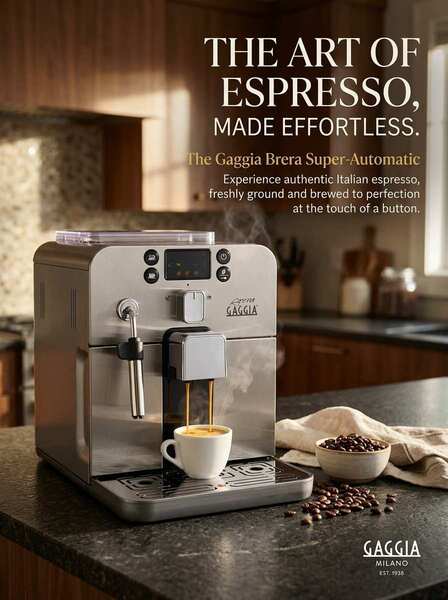
The Gaggia Brera is one of the most appealing choices for anyone who wants a relatively compact automatic espresso machine without moving into the premium price category.
Its appeal comes from its straightforward approach. Rather than overwhelming us with an enormous drink menu, the Brera focuses on the fundamentals: freshly ground coffee, automatic espresso preparation, and simple everyday operation.
The machine is particularly attractive for drinkers who primarily want espresso and coffee and do not need a huge selection of automated milk beverages.
Its integrated grinder means we can use whole coffee beans rather than relying on pre-ground coffee. This gives the machine an important advantage over many basic pod-based systems.
The compact design is another reason to consider it. Kitchen counter space can be surprisingly valuable, especially in smaller apartments or homes where a large premium machine may feel excessive.
Gaggia Brera Pros
- Compact footprint
- Integrated coffee grinder
- Straightforward operation
- Good choice for everyday espresso
- Suitable for users entering the bean-to-cup category
- Generally easier to justify than premium machines
Gaggia Brera Cons
- Fewer advanced features than premium machines
- Milk preparation is less automated than on high-end competitors
- Smaller selection of one-touch specialty drinks
- Less customization than premium models
The Brera makes the most sense when simplicity and value are more important than maximum automation.
For anyone researching the machine, a detailed Gaggia grinder guide can also be useful because grinder adjustment has a meaningful impact on the final cup.
Gaggia Anima: A Strong Step Up for Everyday Coffee
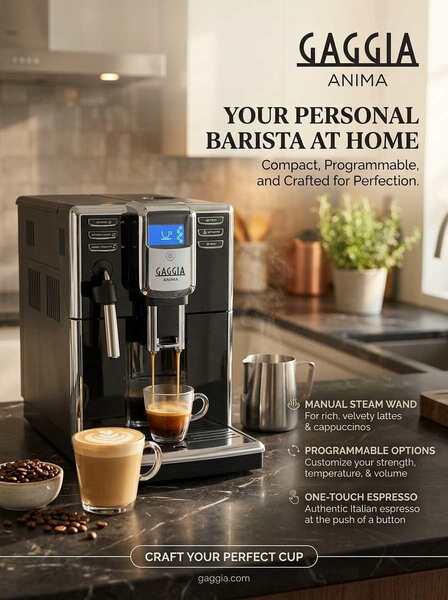
The Gaggia Anima occupies an interesting position between affordable automatic machines and more sophisticated premium systems.
We consider it particularly appealing for households that want the convenience of bean-to-cup coffee but still care about espresso customization.
The Anima provides a more substantial platform for everyday coffee preparation than many entry-level alternatives. Its design emphasizes practical controls and straightforward access to commonly used beverages.
One of its biggest strengths is versatility. We can use it for espresso, longer coffee drinks, and milk-based beverages depending on the configuration and accessories.
The machine also provides greater control over coffee strength and quantity than extremely basic automatic machines.
For someone who drinks several cups every day, these small conveniences become important. A machine that saves a few minutes every morning can quickly become one of the most frequently used appliances in the kitchen.
Who Should Choose the Gaggia Anima?
The Anima is particularly suitable for people who want:
- Freshly ground coffee every day
- More control than an entry-level machine
- A relatively straightforward interface
- Espresso and milk-based drinks
- A machine suitable for regular household use
- A balance between convenience and customization
It is not necessarily the machine for someone who wants an enormous selection of automated specialty drinks. Instead, it is a sensible choice for people who prioritize consistent everyday coffee without unnecessary complexity.
Jura Z10: Best Premium Super-Automatic Espresso Machine
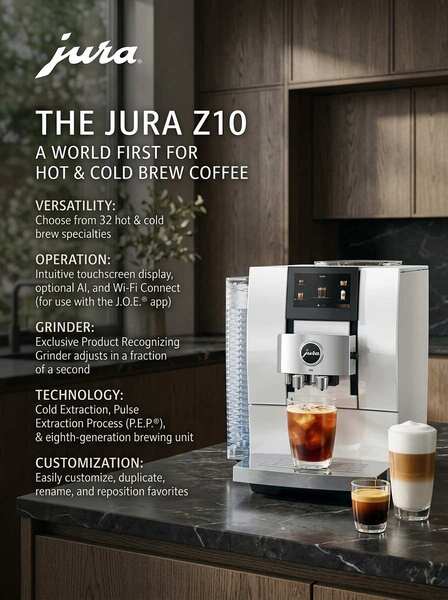
At the other end of the spectrum, the Jura Z10 represents what happens when convenience, technology, and customization become the primary priorities.
The Z10 is designed for coffee drinkers who want far more than a basic espresso machine.
Its appeal comes from the breadth of beverages and the level of automation available. Depending on the selected drink, the machine can handle the grinding, brewing, and milk preparation with very little manual intervention.
For households with several coffee drinkers, that flexibility can be particularly valuable.
One person might want a strong espresso in the morning, another may prefer a cappuccino, while someone else might want a longer coffee later in the day. A premium machine such as the Z10 can accommodate those different preferences far more effectively than a basic bean-to-cup system.
Why the Jura Z10 Stands Out
The Z10 is built around the idea that the machine should handle as much of the coffee-making process as possible.
Its sophisticated interface makes it possible to customize drinks while retaining the convenience that defines the super-automatic category.
The machine is particularly attractive to users who appreciate technology and want an appliance that feels more like a premium coffee station than a simple espresso maker.
Of course, that sophistication comes at a price.
A premium machine requires a substantially larger investment than a compact Gaggia model. For someone who drinks one espresso every morning, the additional cost may be difficult to justify.
For a household that regularly prepares multiple specialty beverages, however, the calculation can look very different.
Gaggia Brera vs. Gaggia Anima vs. Jura Z10
The differences become easier to understand when we look at the machines according to their intended users.
| Feature | Gaggia Brera | Gaggia Anima | Jura Z10 |
|---|---|---|---|
| Overall positioning | Entry-level | Mid-range | Premium |
| Integrated grinder | Yes | Yes | Yes |
| Espresso focus | Strong | Strong | Excellent |
| Customization | Basic | Moderate | Extensive |
| Milk automation | Limited | Moderate | Advanced |
| Drink variety | More limited | Moderate | Extensive |
| Counter-space appeal | Strong | Good | Lower |
| Technology | Straightforward | Practical | Advanced |
| Best for | Simplicity | Everyday versatility | Luxury coffee experience |
The Gaggia Brera is the sensible choice when compactness and affordability matter most.
The Gaggia Anima makes more sense when we want a broader everyday coffee experience without paying premium-machine prices.
The Jura Z10 is the machine to consider when budget is less restrictive and we want maximum automation, customization, and beverage variety.
Why Bean-to-Cup Coffee Is So Convenient
One of the biggest reasons people choose super-automatic machines is simple: they remove friction from the morning routine.
With a traditional espresso setup, we may need to grind beans, measure the dose, tamp the coffee, extract the shot, knock out the puck, steam milk, and clean the equipment.
None of these tasks is particularly difficult, but together they can turn a two-minute coffee into a much longer process.
A super-automatic machine reduces that workflow dramatically.
We place the beans in the hopper, fill the water reservoir, select our beverage, and let the machine do the work.
That convenience becomes especially valuable on busy mornings.
It also makes espresso more accessible to households where only one person has an interest in learning traditional barista techniques.
Super-Automatic vs. Semi-Automatic Espresso Machines
A semi-automatic espresso machine gives us more control.
We choose the grinder settings, dose the coffee, tamp the grounds, control the extraction, and typically steam the milk ourselves.
This can produce excellent results, but it requires more knowledge and practice.
A super-automatic machine reverses the priorities.
We sacrifice some manual control in exchange for speed, consistency, and convenience.
Neither approach is universally better.
For someone who enjoys experimenting with extraction variables, a semi-automatic machine can be far more satisfying.
For someone who wants a cappuccino before work without cleaning a portafilter, a super-automatic machine is likely to be the better fit.
How We Get Better Espresso From a Super-Automatic Machine
Even the best automatic machine cannot compensate for poor beans or incorrect settings.
The first step is choosing fresh coffee beans.
We should avoid buying enormous quantities unless we consume coffee quickly. Coffee loses freshness over time, particularly after roasting.
Grinder settings also matter.
If espresso tastes thin and sour, the grind may be too coarse or the extraction may be too short. If the coffee tastes harsh and bitter, the grind may be too fine or the extraction may be excessive.
We should change one variable at a time rather than adjusting everything simultaneously.
Coffee strength settings can also be useful, but increasing strength is not always the solution. A better grind setting and fresher beans can produce a more balanced cup without simply increasing the amount of coffee.
The Importance of Water Quality
Water is often overlooked when purchasing an espresso machine.
Yet coffee is largely water, so water quality inevitably affects the final drink.
Hard water can also contribute to mineral deposits inside the machine. Regular descaling according to the manufacturer’s recommendations is therefore important.
If the local water supply is particularly hard, using appropriately filtered water can help reduce mineral buildup and potentially improve flavor.
We should always follow the specific machine’s instructions rather than assuming that every filter or descaling method is interchangeable.
Cleaning a Super-Automatic Espresso Machine
Maintenance should be considered part of owning a bean-to-cup machine rather than an optional chore.
The coffee grounds container and drip tray should be emptied regularly.
Milk components require particular attention because dairy residue can become unpleasant and unhygienic if left inside tubing or containers.
The brewing system also needs appropriate cleaning at the intervals specified by the manufacturer.
Descaling is equally important where mineral buildup is a concern.
The exact maintenance schedule varies by machine, water hardness, and usage, so we should use the manufacturer’s instructions as the primary reference.
A clean machine generally produces a more consistent coffee experience and helps protect the internal components.
Are Expensive Super-Automatic Espresso Machines Worth It?
The answer depends on how we use the machine.
If we drink one basic coffee every morning, spending several times more for a premium model may not deliver proportional value.
However, the calculation changes if we regularly prepare:
- Espresso
- Americano-style coffee
- Cappuccino
- Latte
- Flat white
- Macchiato-style drinks
- Specialty milk beverages
- Multiple drinks for different people
In that situation, the convenience of a premium machine becomes much more significant.
A household may also value personalization. If several people have different coffee preferences, customizable drink profiles can save time and make the machine considerably more useful.
The Jura Z10 is therefore easier to justify for a coffee-focused household than for someone who simply wants caffeine before work.
Can Super-Automatic Machines Make Good Espresso?
Yes, but expectations should remain realistic.
A high-quality super-automatic machine can produce very enjoyable espresso, especially when paired with fresh beans and appropriate settings.
However, someone pursuing the absolute highest level of espresso extraction may still prefer a high-end semi-automatic or manual setup.
Traditional espresso equipment allows much greater control over variables such as dose, grind distribution, tamping, extraction time, pressure, and milk texture.
Super-automatic machines deliberately hide much of that complexity.
That is precisely why they are so convenient.
The goal is not to replicate every aspect of professional barista preparation. The goal is to produce a good cup of coffee consistently and conveniently.
Best Super-Automatic Espresso Machine for Small Kitchens
For limited counter space, we would start with the Gaggia Brera.
Its compact design makes it easier to integrate into a smaller kitchen without sacrificing the major benefit of bean-to-cup preparation.
This is especially useful for apartments, small kitchens, guest suites, and home offices.
A large premium machine can provide considerably more functionality, but that functionality requires additional counter space.
When choosing a machine for a small kitchen, we should measure more than the width.
Consider the space required to open the water tank, remove the grounds container, access the brew group if applicable, and refill the bean hopper.
A machine that technically fits the counter may still be inconvenient if there is insufficient clearance around it.
Best Super-Automatic Espresso Machine for Milk Drinks
For people who regularly drink cappuccinos and lattes, the milk system deserves priority over almost everything else.
Premium machines such as the Jura Z10 are particularly attractive because automation reduces the number of steps required to prepare milk-based beverages.
However, we should remember that automatic milk systems require cleaning.
The more frequently we use milk drinks, the more important convenient milk-system maintenance becomes.
For occasional cappuccino drinkers, a simpler machine may make more sense. For households where several people drink milk-based coffee every day, premium automation can provide a meaningful quality-of-life improvement.
Best Super-Automatic Espresso Machine for Beginners
The Gaggia Brera is an appealing starting point because it does not require us to master espresso techniques before enjoying freshly ground coffee.
Its straightforward approach makes it less intimidating than machines packed with advanced menus and settings.
The Gaggia Anima is another strong choice when we want additional flexibility.
For beginners, we recommend starting with a simple coffee recipe and learning how grind adjustment and coffee strength influence flavor. Once those basics become familiar, customization becomes much easier.
Best Premium Choice for Coffee Enthusiasts
For users who want the most sophisticated experience from a super-automatic machine, the Jura Z10 deserves serious consideration.
Its appeal isn’t simply the number of beverages it can prepare. The bigger advantage is the combination of automation, customization, interface design, and premium positioning.
It is designed for people who want the machine to become a central part of their coffee routine.
The Z10 also makes sense for households where coffee preferences vary significantly. Instead of maintaining several appliances or preparing each drink manually, one machine can handle a broad range of beverages.
Other Coffee Machines Worth Exploring
The super-automatic category is only one part of the modern home-coffee market.
Some users may prefer a Cuisinart coffee machine for a different balance of convenience and brewing style, while others may want to explore newer and more distinctive options such as the Cumulus Coffee Machine.
The Cumulus Coffee Machine is particularly relevant for readers interested in how modern coffee appliances are evolving beyond traditional espresso machines. Comparing its approach with established bean-to-cup systems can help us decide whether we prioritize automation, convenience, design, brewing flexibility, or a more specialized coffee experience.
AI-powered coffee makers are also becoming an interesting category to watch as manufacturers experiment with connected appliances, personalized settings, and increasingly intelligent interfaces.
For readers comparing different types of coffee equipment, our related guides can provide a broader view of the market.
How Much Should We Spend on a Super-Automatic Espresso Machine?
There is no universal ideal budget.
Instead, we should match the machine to our actual coffee habits.
Lower Budget
At the lower end, the priority should be reliable espresso preparation, an integrated grinder, straightforward controls, and reasonable maintenance.
The Gaggia Brera is particularly relevant here.
Mid-Range
Moving upward gives us greater customization, better convenience, and more flexibility for households with different coffee preferences.
The Gaggia Anima sits comfortably within this kind of conversation.
Premium
At the premium coffee makers level, we are paying for sophisticated automation, extensive drink options, personalization, premium construction, and a more advanced user experience.
This is where the Jura Z10 becomes particularly interesting.
The mistake is assuming that the most expensive machine automatically produces coffee that tastes several times better.
Price and cup quality do not increase in a perfectly linear relationship.
A machine costing twice as much may provide dramatically more convenience without producing coffee that tastes twice as good.
Our Super-Automatic Espresso Machine Buying Checklist
Before purchasing, we recommend checking these factors:
1. Grinder:
Does the machine provide sufficient grind adjustment for the beans we use?
2. Coffee strength:
Can we adjust the strength and volume?
3. Temperature:
Does the machine provide appropriate temperature control?
4. Milk system:
Do we want automatic milk preparation or manual steaming?
5. Water reservoir:
Is the capacity sufficient for our household?
6. Bean hopper:
Can it hold enough beans without becoming inconvenient to refill?
7. Cleaning:
Are the removable components easy to access?
8. Drink selection:
Are we paying for drinks we will actually use?
9. Counter space:
Will the machine fit comfortably with enough clearance for maintenance?
10. Long-term ownership:
Are filters, cleaning products, and replacement components readily available?
This checklist can prevent us from choosing a machine based purely on appearance or the number of buttons on the front.
Final Verdict: Which Super-Automatic Espresso Machine Should We Choose?
The best super-automatic espresso machine in 2026 depends heavily on what we value most.
The Gaggia Brera is an excellent choice for people who want a relatively compact and straightforward bean-to-cup machine. It focuses on the essentials and makes sense for households that don’t need a huge specialty-drink menu.
The Gaggia Anima is a stronger option when we want a more versatile everyday coffee machine with additional customization and flexibility.
The Jura Z10 sits at the premium end and is designed for people who want an advanced, highly automated coffee experience. Its extensive capabilities make it particularly attractive to households that prepare multiple types of coffee throughout the day.
Ultimately, we should choose based on how we actually drink coffee, not simply how impressive a specification sheet looks.
If espresso is the priority, grinder quality and brewing consistency should come first. If cappuccinos and lattes dominate the morning routine, the milk system deserves more attention. If several people use the machine, personalization and drink variety become much more valuable.
For a first bean-to-cup machine, keeping things simple can be a smart decision. For an established coffee enthusiast who wants maximum convenience, investing in a premium machine can be worthwhile.
The strongest super-automatic espresso machine is therefore not necessarily the most expensive one. It is the machine that gives us the right combination of coffee quality, convenience, customization, maintenance, and value for our daily routine.