
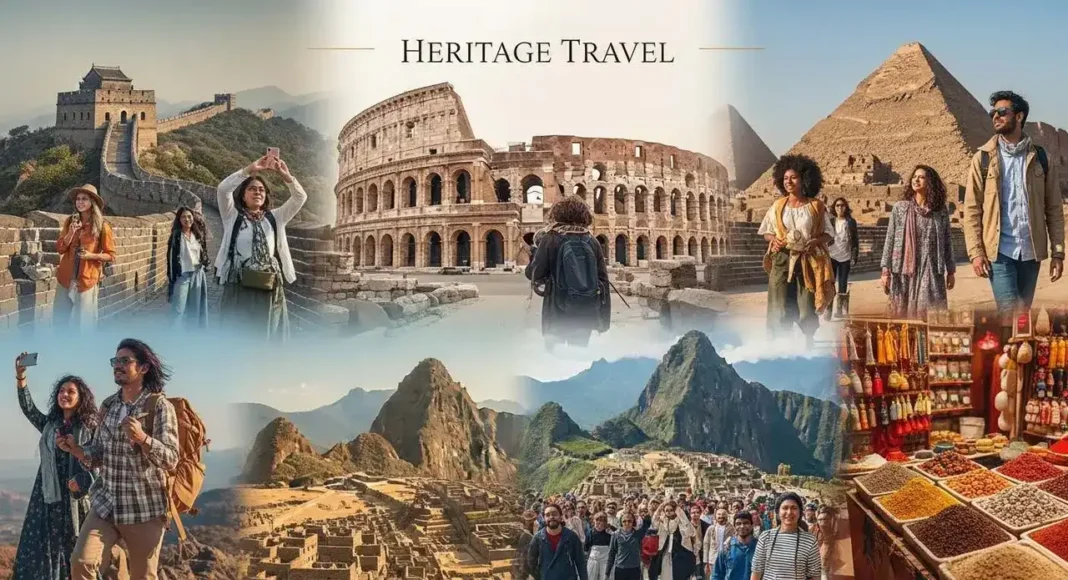
The five-star stay alone is no longer enough. In 2026, ultra-high-net-worth travellers want a genetic connection to their destination — and the industry is building an entirely new category to deliver it.
Imagine holding a centuries-old baptismal record in a Florentine archive. Or standing in a Bhutanese valley your ancestors never visited, but whose spiritual frequencies somehow feel encoded in your cells.
In 2026, heritage travel — what the industry is now calling “ancestry expeditions” — has crossed the threshold from niche hobby into the most coveted form of five-star luxury the world has ever seen.
Table of Contents
From Sightseeing to Self-Discovery: The Meaningful Travel Revolution
For decades, luxury travel was defined by access: the private beach, the Michelin-starred tasting menu, the butler who remembered your pillow preference.
Those elements still matter. But something deeper has happened to the global traveller’s psyche — a collective awakening to the question that no amount of thread-count or champagne can answer: Who am I, and where do I come from?
The ancestry travel boom is not merely sentimental. It is data-driven, genetically powered, and economically formidable.
According to industry analysis, the heritage travel market is projected to reach over $675 billion in 2026, growing at a compound annual rate of approximately 6% — making it one of the most resilient segments of the global tourism economy.
The catalyst? The mass democratisation of at-home DNA testing and the widespread digitisation of historical records, which have transformed genealogy from a dusty hobby into a precision-guided travel planning tool.
$675B Heritage Travel Market 2026
In 2026, specialised genealogical platforms no longer merely list broad ethnic percentages. They connect users to specific geographic “micro-regions” — a result showing “30% German” is no longer an abstraction; it is a directive to visit a specific municipality in the Rhineland, to find the church registry, to taste the food grown in that soil.
A “genetic connection” to a destination has become, for discerning travellers, as important as the quality of the suite itself.
2026 will be defined by a shift toward experience-led journeys, where travellers seek deeper meaning, emotional connection, and authentic cultural engagement.— Iyad Rasbey, VP Destination Tourism Development, Ras Al Khaimah Tourism Development Authority
This is what travel industry analysts are calling the “meaningful” shift — a pivot from passive consumption (ticking destinations off a list) to active participation in one’s own story.
And nowhere is this shift more pronounced than among Ultra-High-Net-Worth Individuals (UHNW), who increasingly have the means to travel anywhere on Earth but choose, above all else, to travel with purpose.
Luxury Hotels That Craft the Heritage Experience
Not every five-star hotel has grasped what the new ancestry expedition traveller actually needs. The ones who have are building an entirely different category of hospitality — one that blends bespoke genealogical research, deep cultural immersion, and extraordinary physical environments into a seamless whole.
Amankora, Bhutan — The Pilgrimage Model of Heritage Luxury
Perhaps no property in the world better embodies the spirit of the ancestry expedition than Amankora, Aman’s circuit of five lodges set across the central and western valleys of Bhutan — the Himalayas’ last Buddhist kingdom.
The very name combines “Aman” (peace) and “Kora” (a circular pilgrimage in Dzongkha), and that etymological fusion is not accidental.
The Amankora experience is explicitly designed as a journey of self and spiritual discovery, not merely a resort stay.
Guests do not simply check in and check out. They undertake a lodge-to-lodge circuit — from Paro through Thimphu, Punakha, Gangtey, and Bumthang — where each valley reveals a distinct facet of Bhutanese cultural heritage.
At Amankora Bumthang, guests dine in an authentic farmhouse adjacent to the Royal Wangdichhoeling Palace, birthplace of Bhutan’s monarchy. In Gangtey, rare endangered black-necked cranes migrate from Tibet, a spectacle framed by the 16th-century Gangtey Goemba monastery.
The Aman team provides bespoke itineraries, coordinates international visas, processes the Bhutan Sustainable Development Fee, and handles every logistical detail — leaving guests entirely free to be present.
Price From ~$1,300 USD per person/night
Stay 7–14 nights across 5 lodges
Ideal For Solo heritage travellers, spiritual journeys
Peak Seasons March–May, Sept–Nov
Beyond Bhutan, the luxury heritage hospitality model is taking root in Europe’s ancestral heartlands.
High-end properties in Dublin now employ dedicated “Genealogy Butlers” — specialists who guide guests through the National Library’s civil records, Church of Ireland registers, and Griffith’s Valuation land surveys.
In Florence, the concierge at certain historic palazzos can arrange private audiences with archivists at the Archivio di Stato, where family records stretch back to the 13th century.
Artisans of Leisure, one of the leading bespoke heritage tour operators, has formalised this model by offering private appointments with archivists and historians at local records offices, excursions with dedicated drivers to ancestral towns, translators for archival meetings, and exclusive cultural experiences — including commissioned designs based on family crests and regional heraldry.
The luxury is not the room; it is the research infrastructure placed entirely at the traveller’s disposal.
How Travel Designers Are Removing the Mental Load
For UHNW individuals, the single greatest luxury in 2026 is not a yacht, a private jet, or even access — it is the complete absence of cognitive burden.
The heritage travel space has become acutely aware of this. Planning a meaningful roots expedition is not like booking a beach holiday.
It requires genealogical pre-research (often taking months), archival coordination across multiple languages, liaison with local historians, translation of handwritten records in obsolete scripts, and the emotional intelligence to frame discoveries — both joyful and painful — in a supportive travel context.
The top-tier travel designers operating in this space now offer what can only be described as a complete concierge-intelligence model.
The traveller provides their DNA results, a family surname, and a preferred travel window. Everything else — from sourcing a 17th-century land deed in a Polish parish registry to arranging a private dinner with a family who shares your Breton surname — is handled invisibly, invisibly being the operative word.
1 Pre-Departure Genealogy Research
Specialist firms digitise and translate relevant records before the trip begins, so travellers arrive equipped with a fully compiled “Genealogy Dossier” — a curated archival narrative of their lineage in the destination.
2 On-the-Ground Expert Access
Local historians, archivists, and cultural interpreters — not generic tour guides — accompany guests. Where a surname is traced to a specific village, the relevant parish priest or municipal archivist may be pre-arranged as a private contact.
3 Emotional Curation
Heritage travel can uncover unexpected stories — migration under hardship, lost children, changed surnames. The best travel designers now include a cultural psychologist or narrative specialist in the planning team, ensuring the emotional arc of discovery is held with care.
4 Legacy Documentation
The journey is memorialised into a bespoke “Heritage Book” — a beautifully produced bound volume combining archival images, family records, photographs from the journey, and the traveller’s own written reflections — delivered to their home after return.
The World Luxury Chamber of Commerce’s 2026 forecast confirms this direction precisely: “Travel in 2026 will prioritise meaning over materialism, as UHNWIs increasingly seek experiences that create emotional impact, authenticity, and cultural resonance.”
The concierge-intelligence model removes every logistical friction so that the traveller can be wholly present for the moments that matter most.
Top 3 Regions for Heritage Discovery in 2026
Based on 2026 travel data, genealogical platform activity, and luxury booking intelligence, three regions stand out as the premier destinations for ancestry expeditions this year.
Each offers a distinct combination of archival depth, cultural immersion, and world-class heritage hospitality infrastructure.
Western Europe
Ireland & The Celtic Diaspora Trail
Ireland remains the apex destination for ancestry travel, particularly for the North American diaspora.
Government-supported genealogical services, recently expanded digital archives at the National Library, and the emotional landscape of post-Famine migration make it uniquely powerful for travellers tracing Irish roots.
Luxury heritage operators pair private archival access in Dublin with bespoke journeys to ancestral townlands in Connacht, Munster, or Ulster — including introductions to locals who share the traveller’s family name.
Zicasso’s 2026 data shows a significant surge of travellers bypassing popular Greek islands in favour of Ireland’s coastal drama and Celtic heritage, reflecting a wider “depth over distance” movement.DNA Match: Irish, Scottish, Welsh Best Season: May–September
Southern Europe
Italy: The Archival Heartland
Italy’s heritage travel infrastructure is arguably the most sophisticated in the world. State archives (Archivi di Stato) in cities from Palermo to Venice hold parish records, notarial acts, and land registers stretching back to the 13th century.
For travellers with Italian ancestry — particularly from Sicily, Calabria, or the Veneto — a luxury heritage expedition can include private viewings of original birth and marriage certificates, visits to the exact farmhouse or palazzo a family once occupied, and introductions to current residents who may share a family connection.
High-end Florence and Rome properties now routinely employ “Genealogy Concierge” services, and bespoke operators run private archival tours that are unavailable to the general public.DNA Match: Italian, Sicilian, Sardinian Best Season: April–June, Sept–Oct
Asia-Pacific & Middle East
Japan & The Gulf: The Fastest-Growing Heritage Markets
While Europe dominates in volume, the Asia-Pacific and Middle Eastern regions are the fastest-growing heritage travel markets in 2026, fuelled by government initiatives like Saudi Vision 2030 and a rising global interest in cultural preservation.
Japan offers perhaps the world’s most meticulous archival culture — the koseki (family register) system allows travellers of Japanese descent to trace family lineage with extraordinary precision, often to specific village shrines and seasonal festivals.
The Gulf, meanwhile, is developing a new category of tribal heritage travel: curated expeditions into Bedouin ancestral territories, historical trading routes, and pre-oil cultural landscapes, framed by ultra-luxury desert camps operated by properties like Aman’s forthcoming Gulf portfolio.
Both regions offer what Europe cannot: the sense of encountering a heritage that has been, until now, largely inaccessible to the Western traveller’s imagination.DNA Match: Japanese, Chinese, Gulf Arab Fastest Growing 2026
The Most Personal Journey Is the One Back
In a travel landscape saturated with overwater villas and private island buyouts, the ancestry expedition has emerged as the ultimate differentiator — not because it is the most expensive, but because it is the most irreplaceable.
No two heritage journeys are the same. They cannot be replicated, resold, or experienced by anyone else on Earth. They are, by definition, yours alone.
The five-star stay is the setting, not the story. The story begins the moment a traveller steps into an archive, holds a document their great-grandmother once signed, or walks the same cobblestones that a now-vanished version of their family once walked daily.
That moment — quiet, unhurried, profound — is what luxury travel in 2026 is being rebuilt around.
The market has heard the signal. The infrastructure is being constructed. The only question remaining is: which part of the world is waiting to tell you who you are?