
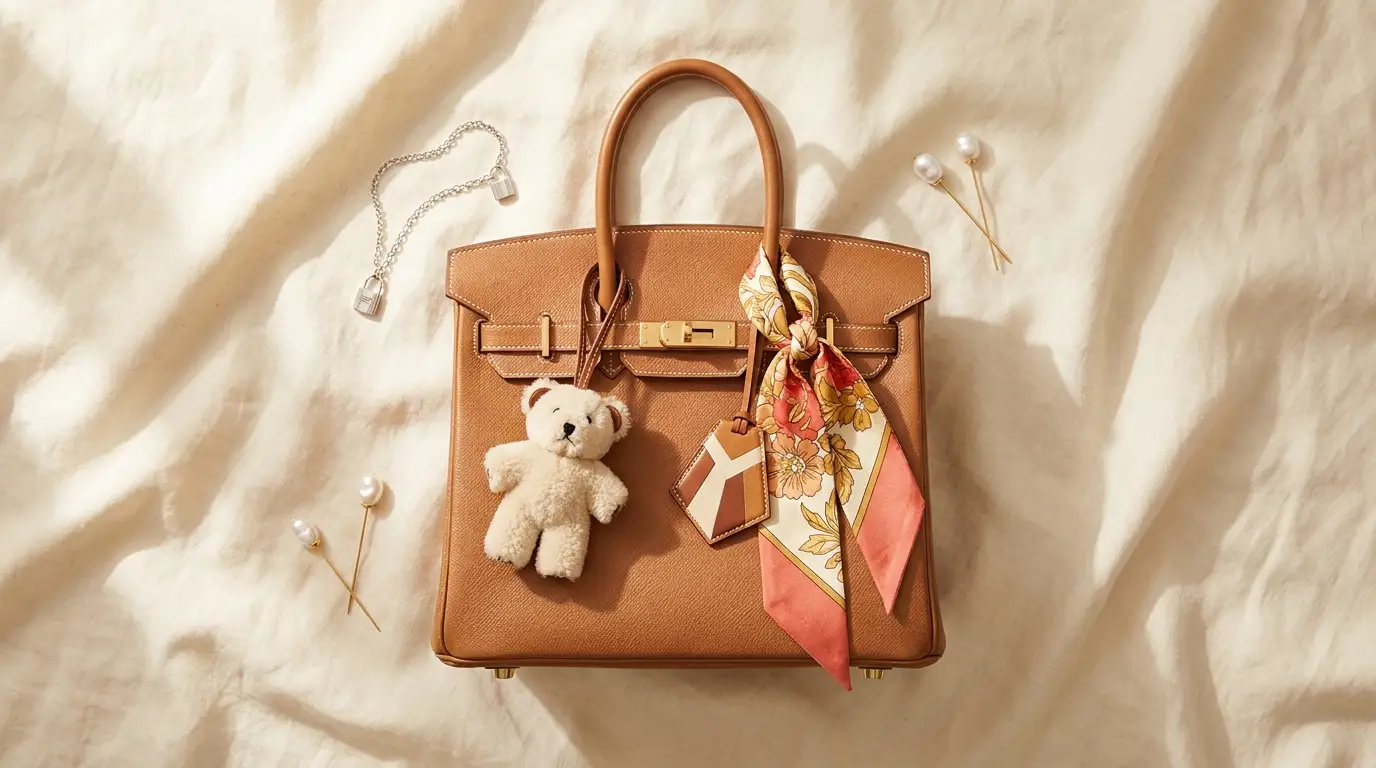

For decades, the allure of a luxury handbag rested on a single, unspoken agreement: you bought the logo, and the logo spoke for you.
A Birkin on your arm, a Speedy on your shoulder, a Puzzle clutched in your hand — the brand did the talking. Status was uniform, aspirational, and, above all else, pristine. Then something shifted.
A new generation of collectors — fluent in resale markets, educated in craft, and deeply resistant to conformity — started asking a different question entirely. What if the bag is just the beginning?
Enter the era of luxury bag charms and hyper-personalization: the defining aesthetic movement of 2026, where the world’s most coveted heritage handbags are being reimagined not as finished objects, but as living canvases for individual expression.
Table of Contents
The “Jane Birkin Effect” Reimagined for 2026
To understand where we are, you have to start with Jane herself. When the actress and icon began loading her Hermès Birkin with scarves, stickers, woven baskets, and haphazard trinkets in the 1970s and ’80s, she wasn’t making a fashion statement — she was making a life statement.
The bag was a document of her days. It was chaotic, specific, and absolutely irreplaceable. You could not buy what Jane Birkin carried, because what she carried was her.
That energy — the idea of a luxury bag as autobiography rather than trophy — has returned with extraordinary force. But in 2026, it arrives with an entirely new layer of intentionality.
From “Pristine” to “Lived-In Luxury”
The cultural pendulum has swung decisively away from the “no-touch” mentality that dominated the early 2020s, when many collectors kept their investment bags in dust bags, displayed under glass, or rotated so carefully they barely accumulated wear.
That approach made a certain kind of sense during a period of extreme scarcity and sky-high resale premiums — if a Birkin 25 in Etoupe was appreciating at 15% annually, why personalize it?
The answer, increasingly, is because you want to. A new cohort of luxury consumers — many of them entering the market through resale platforms rather than boutique waitlists — is far more interested in how a piece makes them feel day-to-day than in its theoretical resale ceiling. They style their bags. They wear them. And they adorn them.
The aesthetic that has emerged from this shift is what editors are calling “lived-in luxury”: a deliberate cultivation of the personal, the layered, and the one-of-a-kind, achieved without ever compromising the underlying integrity of the investment piece.
The Psychological Shift: From Gatekept to Genuinely Personal
There is something more philosophical happening beneath the surface of this trend. For years, luxury fashion operated on a system of gatekeeping — access to the right bags at the right boutiques required relationships, purchase history, and a fluency in unwritten rules.
That system produced incredible desire, but it also produced a kind of homogeneity. Everyone who “made it” to the top of a waitlist received the same bag.
Hyper-personalization is, in part, a direct response to that sameness. It is a way of saying: I have the heritage piece, and it is mine in a way yours is not. It restores a sense of individual agency to an industry that had, for a time, made conformity feel like the ultimate luxury.
The “One-of-One” Concept
The phrase “one-of-one” has migrated from streetwear and NFT culture into the mainstream luxury vocabulary, and its application to heritage handbags is entirely logical. A Hermès Birkin is, by definition, a mass-produced object — extraordinarily crafted, yes, but produced in volume.
What transforms it into a one-of-one is the curation of accessories around it: the specific Rodeo charm tied to its handle, the vintage twilly looped through its hardware, the sterling silver key ring clipped to its d-ring. That constellation of choices is yours alone.
The result is that two women can carry the same bag in the same color, the same season, and they will not be carrying the same bag at all.
Top Luxury Bag Charm Trends Dominating the Season
The vocabulary of bag charm styling has expanded dramatically. What was once a single decorative gesture has evolved into a full design discipline, with its own principles of composition, material hierarchy, and seasonal expression.
The “Charm Stack”: Curated Clusters Over Single Statements
The single charm — one silk Pegasus, one leather Rodeo — still has its place, but the dominant trend of the season is the charm stack: a carefully assembled cluster of two to five charms in dialogue with one another.
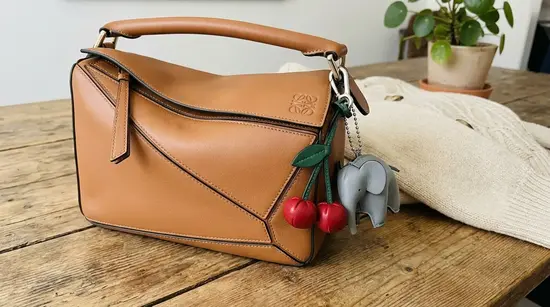
Think textures in conversation — a smooth patent leather cherry bag charm sitting beside a rough-napped shearling bear, anchored by a slim chain of oxidized silver links. The goal is not matching; the goal is curation. Each piece should feel deliberately chosen and yet surprising in combination.
Stylists working in this space talk about charm stacking the way musicians talk about chord progressions — individual notes that become something richer together. The rules are loose, but the intention must be there.
Materials to Watch in 2026
Leather marquetry is having an extraordinary moment. Artisans trained in the tradition of Florentine intarsia are now applying the technique to miniature leather goods — tiny bags-within-bags, geometric pendants, and trompe-l’oeil charms that look like precious stones but are constructed from razor-thin layers of hand-dyed calf and nappa leather. The craftsmanship involved is breathtaking, and the exclusivity is real.
Sterling silver and oxidized metalwork continue to anchor the more architectural end of the market. Small-scale sculptural charms — abstract forms, celestial motifs, micro-portraits — commission from independent jewelers and silversmiths are appearing on Birkins and Kellys alongside pieces from major houses, and they hold their own entirely.
Tech-integrated charms represent the most forward-looking corner of the category. NFC-enabled pendants — small enough to pass as decorative, sophisticated enough to carry a digital certificate of ownership or link to a private video — are being quietly adopted by collectors who exist at the intersection of luxury and Web3 culture.
Some limited drops have linked physical charms to NFT companions, creating dual-asset collectibles that live both on the bag and on the blockchain.
Vintage & Heritage Charms: The Archive as Accessory
Some of the most compelling charm styling happening right now involves no new purchases at all. Collectors with access to archival Hermès twillys — the narrow silk scarves produced in limited seasonal editions since the 1980s — are looping them through handles and hardware, transforming what are already collectible objects in their own right into living accessory elements.
Heirloom jewelry — a grandmother’s brooch repurposed as a bag pin, a childhood locket clipped to a chain — brings a dimension of personal narrative that no retail purchase can replicate.
This approach is perhaps the purest expression of the hyper-personalization ethos: the bag becomes a wearable family archive.
High-End Brands Leading the Movement
Loewe & Hermès: The Gold Standard
No serious conversation about luxury bag charms begins anywhere other than Hermès. The house has been producing leather bag charms for decades — the Rodeo, in its various sizes and skins; the Pegasus; the Bolduc ribbon charm — and each has developed its own secondary market, its own collector culture, its own micro-economy.
A limited-edition Hermès Rodeo in a rare skin can trade for multiples of its retail price, and the house’s restraint in production has made even its entry-level charms feel genuinely special.
Loewe, under Jonathan Anderson’s creative direction, has approached the category from a place of conceptual playfulness without sacrificing craft.
The brand’s leather charms — including its beloved Bunny, Elephant, and Cherry designs — are executed in the same quality of leather as its bags themselves, making them feel like serious objects rather than afterthoughts.
Loewe’s approach has also helped establish the idea that a charm should have its own design integrity, not merely defer to the object it adorns.
Miu Miu & Prada: The Cluttered Aesthetic
Where Hermès and Loewe operate in the register of restrained excellence, Miu Miu and its parent house Prada have embraced what can only be described as deliberate maximalism.
The “cluttered” aesthetic — bags festooned with keyrings, pendants, clips, and miniature accessories in apparent abundance — has been a runway presence for several seasons now and has translated powerfully into the real world.
Miu Miu’s customer, young, confident, and aesthetically omnivorous, has taken the concept and run with it, creating bag looks that feel genuinely personalized precisely because they refuse to be tidy.
The Prada Re-Edition bags, in particular, have become ideal canvas pieces for this approach — their hardware-forward design accepting layered accessories with ease.
The Rise of Niche Artisans
Perhaps the most significant development of the past two seasons is the emergence of boutique charm makers as genuine prestige alternatives to the major houses.
Artisans operating out of Florence, Paris, and Tokyo — many building direct audiences on Instagram and through appointment-only studio visits — are producing leather, ceramic, and mixed-media charms of a quality that competes directly with the heritage brands, at prices that reflect true craftsmanship rather than logo premium.
Several of these makers now have their own waitlists. Some collectors who cannot access a particular Hermès charm through boutique channels are finding equally covetable alternatives through independent artisans who know their customer personally. This democratization of craft excellence is one of the more quietly radical developments in contemporary luxury.
How to Style Your Luxury Bag: A Masterclass in Customization
Understanding the theory behind great bag styling makes the difference between an assemblage that looks considered and one that simply looks busy.
Color Theory: Match, Clash, or Anchor
The starting point for any bag charm composition is hardware. Gold hardware bags — classic in Hermès, dominant in Chanel — accept warm-toned charms most naturally: cognac leathers, tortoiseshell resins, antique brass metalwork, warm ivory silks.
But the more interesting choice, increasingly, is the intentional clash: a cool-toned sterling silver charm against gold hardware creates a tension that reads as deliberately styled rather than accidentally mismatched, provided the rest of the look is controlled.
Silver or palladium hardware opens a cooler palette: slate leathers, dusty mauves, icy whites, deep navy silks. The tonal approach — silvers against silvers, cool neutrals throughout — is the safer route. The bold route is a warm pop: a rich terracotta leather charm or a scarlet silk twilly against a silver-finished bag creates genuine drama.
The key principle, regardless of approach: one element should anchor the composition. That anchor might be a color repeated in both the charm and the bag’s interior lining, or a material that echoes the bag’s own leather. Without an anchor, even a beautifully curated charm stack will read as random.
Proportions & Balance: Micro-Bags vs. Oversized Totes
Scale is everything. A large leather charm — think a full-size Hermès Rodeo PM — is perfectly proportioned on a Birkin 35 or a Speedy 30, where it reads as a deliberate accessory choice. On a Micro Bag or a Kelly 20, that same charm overwhelms the bag’s own silhouette and creates visual imbalance.
For micro and mini bags, the styling principle is delicacy: slim chain charms, small ceramic pendants, or a single looped twilly in a lightweight silk weave. The bag is already making a statement; the charm should whisper in support, not compete.
For oversized totes and work bags — the Celine Cabas, the Goyard Saint Louis, the Bottega Veneta Arco — the inverse applies. A single small charm disappears against the bag’s volume. This is the terrain for charm stacks, for larger sculptural pendants, for a cluster of pieces that give the eye something to land on amidst the expanse.
Seasonal Swaps: A Year-Round Styling System
One of the practical joys of luxury bag charm as a personalization strategy is their seasonality. Unlike embossing or painting, a charm is an entirely reversible commitment, and building a seasonal charm wardrobe is one of the more satisfying ways to refresh a core bag collection without purchasing new pieces.
Autumn/Winter calls for warmth and weight: shearling bears and lambs, chunky oxidized silver chains, deep burgundy or forest green leather marquetry, and velvet ribbon ties in jewel tones.
Spring/Summer opens to lightness: seed-bead clusters in aqua and coral, silk twillys in citrus prints, lightweight resin charms in translucent pastels, and gold-toned metalwork that catches the light.
The transition seasons — when a bag needs to move between a winter coat and a lighter jacket — are where a single, seasonally ambiguous charm earns its keep: a natural tan leather Rodeo, a simple sterling initial charm, or a neutral silk ribbon that reads as deliberately understated against a more dramatic outfit.
The Investment Angle: Does Customization Affect Resale Value?
For collectors who think about their bags as both assets and objects of desire, this question is unavoidable. And the answer, when it comes to charms specifically, is unambiguously good news.
The “Non-Permanent” Edge
The critical distinction in luxury bag customization is between modifications that are permanent and those that are not.
Painting, embossing, monogramming, and hardware swapping all alter the physical integrity of the bag — and while some of these modifications (Hermès’s own monogramming service, for example) add value within specific collector communities, most permanently altered bags trade at a discount on the secondary market, because condition-obsessed buyers simply have fewer options with them.
Luxury bag charm occupy a completely different category. They are entirely reversible. Remove the charm, and the bag is precisely as it was. The hardware it was attached to — d-rings, handle loops, key clips — is typically original to the bag’s design.
A charm-adorned Birkin, when presented for resale without its charms, is graded on its own leather and hardware condition, just as any other example would be. The charm leaves no trace.
This makes bag charms not just the most expressive form of luxury bag personalization, but arguably the smartest — personal expression that costs the bag nothing in resale terms, and may, if specific charms are desirable enough, generate independent secondary market value of their own.
The Collectibility of Limited-Edition Charms
Here the conversation becomes genuinely interesting. Certain Hermès bag charms — the Rodeo in limited petit h materials, the Pegasus in rare skins, seasonal editions produced in very small runs — have established their own robust secondary market entirely separate from the bags they accompany.
A Hermès Rodeo PM in Shiny Alligator can command prices in the secondary market that rival entry-level designer bags outright.
Similarly, select Loewe charms from sold-out seasons, certain Goyard leather accessories, and charms produced by established niche artisans with verifiable provenance are trading with genuine liquidity.
In these cases, a charm stack is not merely an aesthetic choice — it is a portfolio of small, highly portable collectible objects, each of which may appreciate independently over time.
The caveat, as always, is condition and provenance. A charm that shows heavy wear, has lost hardware, or cannot be authenticated will not hold value. Care matters as much here as it does with the bags themselves.
Frequently Asked Questions
What are bag charms called in luxury fashion?
Luxury bag charm exist under several names depending on the house producing them and the form they take. “Bag charms” and “bag pendants” are the broadest categories. Hermès refers to its pendant accessories as “bag charms” in English and “breloques” in French.
A “twilly” specifically refers to Hermès’s narrow silk scarf, frequently used as a handle wrap or charm tie but not a charm in the hanging sense. “Bag accessories” is the umbrella term most commonly used in luxury retail environments.
Can bag charms damage my leather handbag? Tips on protecting delicate leathers.
This is a real concern, particularly for bags with unfinished or “vachetta” leather — the natural, untreated cowhide used on the handles and trim of many Louis Vuitton Monogram pieces, for example.
Vachetta darkens with patina over time and is highly susceptible to moisture and dye transfer. A charm with colored leather or fabric components should never rest directly against vachetta for extended periods; use a thin cloth barrier or choose charms with metallic clasps that attach to hardware rather than contacting the leather directly.
For bags with finished leathers — the smooth calfskin of a Hermès or the grained leather of a Chanel — the risk is lower, but hardware clasps can still scratch delicate surfaces if they swing freely against them.
Consider using a small loop of grosgrain ribbon between the charm’s hardware and the bag’s leather surface as a protective buffer. When storing, always remove charms before placing the bag in its dust bag.
Why is hyper-personalization trending in 2026?
Several forces have converged. The resale market’s maturation has produced a generation of collectors who are highly educated about luxury goods but feel less loyalty to any single house’s aesthetic vision — they curate across brands and eras, and they expect their bags to reflect that curatorial intelligence.
Simultaneously, years of social media visibility have created acute awareness of when two people are carrying the same thing, making genuine differentiation feel both more desirable and more achievable.
The quiet luxury movement of the early 2020s, which stripped fashion down to near-anonymity, has naturally generated a counter-movement toward personality and the personal. Hyper-personalization is, in this sense, the correction: luxury that is still excellent, still investment-grade, but unmistakably you.
Bag Charms & Personalization
Choosing between two iconic brands? Our Coach vs Kate Spade Bag Charms comparison breaks down quality, style, and value. For affordable options, our Best Bag Charms Under $100 rounds up premium-looking picks that won’t break the bank. Explore the trending Cherry Bag Charm styles and the Coach Cherry Charm details every collector should know. For more style inspiration, explore our full Fashion & Style collection.
