
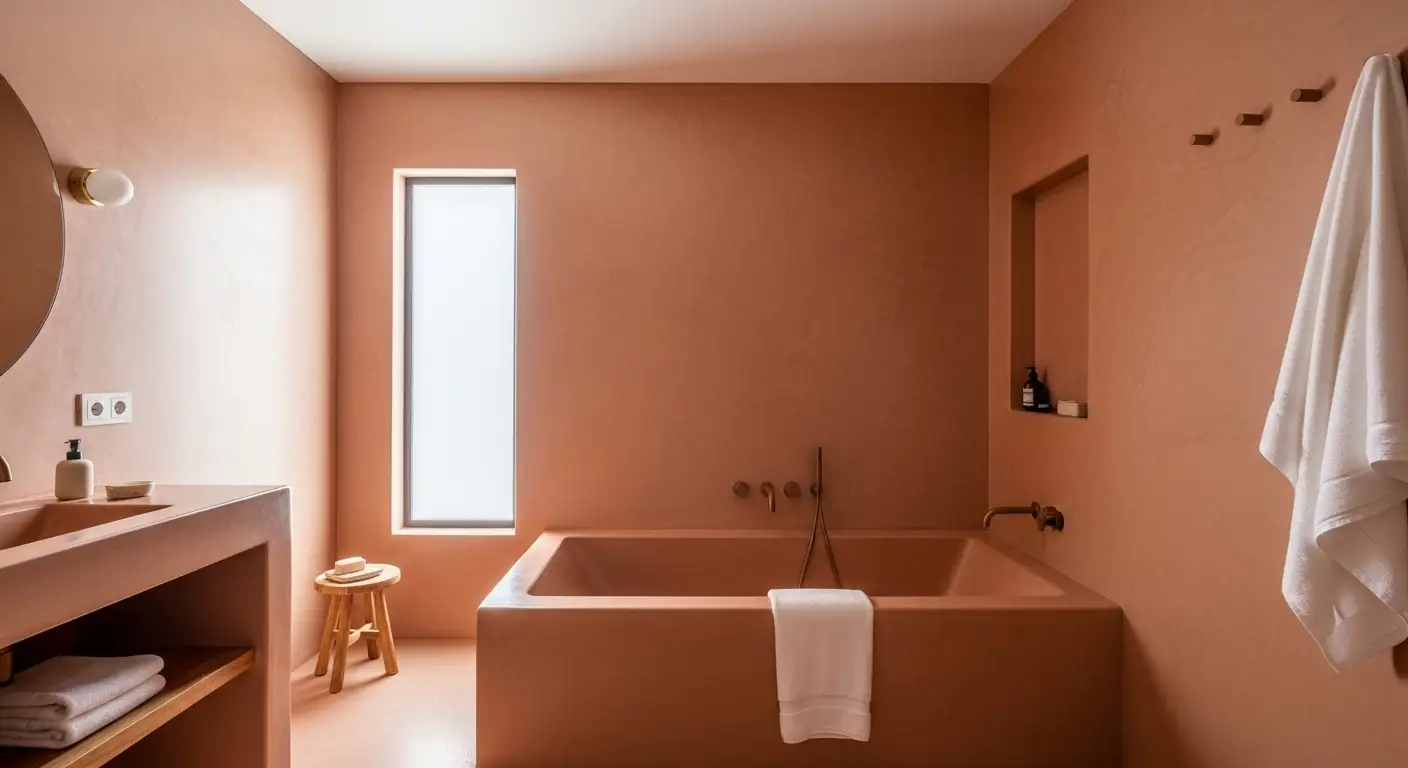

If you’ve ever scrolled through a home design account and stopped dead in your scroll at a bathroom that looked somehow ancient and ultra-modern at the same time — silky smooth walls, warm earthy tones, zero grout lines — there’s a good chance you were looking at a tadelakt bathroom. And now you can’t stop thinking about it. Trust me, I get it.
Tadelakt is one of those materials that just hits differently. It’s been used for over a thousand years in Moroccan architecture, and it’s making a serious comeback in contemporary homes around the world.
In this post, we’ll break down everything you need to know — what it is, how it works, the costs involved, and whether it’s the right choice for your shower, tub, or full bathroom renovation.
Table of Contents
What Exactly Is Tadelakt?
Let’s start at the beginning. Tadelakt (pronounced tad-uh-lakt) is a traditional Moroccan lime plaster that’s been polished to a waterproof, marble-like finish. The name comes from the Arabic word dellek, meaning “to rub” — which is basically the whole secret to the technique.
Craftsmen apply the plaster in layers, then burnish it with a smooth stone while it’s still setting. The result? A seamless, naturally water-resistant surface that’s as beautiful as it is functional.
What makes tadelakt truly special is the chemistry behind it. When lime plaster reacts with black soap (traditionally made from olives), it forms a water-repellent barrier at the surface. No synthetic sealants. No grout. No tiles. Just pure, gorgeous, ancient materials science doing its thing.
This is why the tadelakt bathroom aesthetic feels so timeless — because it literally is timeless.
Why Tadelakt Bathrooms Are Having a Huge Moment Right Now
Here’s the thing: we live in a world of maximalist tile choices, and somehow a surface that’s smooth, matte, and zero grout lines is the most refreshing thing you can put in a bathroom.
Interior designers love it. Boutique hotel developers swear by it. And once you see it in person, you’ll understand why.
Beyond aesthetics, there are some seriously compelling practical reasons to consider tadelakt for your bathroom:
- Naturally waterproof — ideal for wet environments when properly applied and maintained
- Antibacterial properties — the high pH of lime makes it naturally resistant to mold and mildew
- Seamless surface — no grout lines means nothing to scrub and no dark staining over time
- Eco-friendly — lime is a natural, low-carbon material compared to many synthetic alternatives
- Unique finish — no two tadelakt surfaces look exactly alike; yours will be one of a kind
Whether you’re going for a full Moroccan-inspired hammam or a sleek minimalist spa bathroom, tadelakt adapts beautifully to almost any design direction.
Tadelakt Shower: Where It Really Shines
If there’s one place where tadelakt absolutely earns its reputation, it’s the shower. A tadelakt shower is the kind of thing that makes guests do a double-take.
There are no tiles, no grout lines, no seams — just a fluid, sculptural shell of polished lime plaster wrapping around you like a warm hug from ancient Marrakech.
Because tadelakt is applied directly onto a waterproofed substrate, it creates a continuous, monolithic surface.
Water just beads off it (when properly maintained), and the whole thing has this gorgeous organic texture that changes slightly in tone depending on the light.
A few things to keep in mind for your tadelakt shower:
Surface preparation is everything. Your substrate (usually cement board or a solid concrete wall) needs to be absolutely flat, stable, and properly waterproofed underneath. Any flexing or cracking in the base will eventually transfer to the tadelakt surface.
Ventilation matters. Tadelakt loves humidity but needs to dry out properly between uses. Make sure your shower is well-ventilated. A good exhaust fan is your best friend here.
Maintenance is easy but specific. You’ll want to reseal the surface periodically with black soap or a compatible natural wax. Skip the harsh chemical cleaners — they’ll eat away at the lime surface. Gentle is the name of the game.
Tadelakt Bathtub: Yes, It’s a Thing and Yes, It’s Gorgeous
A tadelakt bathtub is probably the most dramatic way to use this material in a bathroom. We’re talking about a custom-sculpted tub — often built in place from a concrete or brick form — coated in tadelakt plaster and polished to a silky finish. The effect is nothing short of stunning.
These aren’t your off-the-shelf acrylic tubs. A tadelakt bathtub is a bespoke, handmade piece that becomes the centerpiece of the room. They’re often designed as built-in, freestanding, or partially-sunken forms that flow organically into the surrounding walls or floor.
Some popular design directions include:
- Moroccan hammam style — low-profile, curved edges, warm terracotta tones
- Contemporary minimalist — clean geometric lines, matte white or light gray finish
- Organic sculptural — asymmetric, flowing forms with a handcrafted quality
One honest note: because tadelakt bathtubs are filled with hot water regularly, they do require more diligent maintenance than walls or showers.
The thermal cycling (filling with hot water, then cooling) can cause micro-movement over time. Choosing an experienced applicator and using a quality substrate is critical for longevity.
Tadelakt Bathroom Cost: Let’s Talk Numbers
Okay, let’s get real for a second — because this is the question everyone has but is sometimes afraid to ask. How much does a tadelakt bathroom actually cost?
The short answer: it’s more expensive than standard tile, but not astronomically so when you factor in what you’re getting.
Tadelakt bathroom cost varies based on several factors:
| Factor | Impact on Cost |
|---|---|
| Surface area | Larger bathrooms = higher total cost |
| Complexity of application | Curves, niches, and intricate forms cost more |
| Applicator experience | Skilled craftsmen charge a premium — worth it |
| Pigmentation | Custom colors may add cost |
| Location | Labor rates vary significantly by region |
As a rough ballpark:
- Materials only: $10–$25 per square foot
- Professional installation: $60–$150+ per square foot (all-in)
- Full bathroom (100 sq ft): $7,000–$20,000+ depending on complexity
Yes, that’s a meaningful investment. But consider what you’re getting: a custom, hand-applied, one-of-a-kind surface that will last decades with proper care, has no grout to regrout, and will make your bathroom look like a luxury boutique hotel in Fes. Not bad, right?
One place where costs can creep up is the prep work. If your existing walls need significant repair or waterproofing work before tadelakt can be applied, budget for that separately.
Pro tip: Get at least three quotes from applicators who specifically specialize in Moroccan lime plasters. General plasterers can technically apply tadelakt, but the burnishing and black soap treatment require specific expertise. The difference in final quality is night and day.
How Tadelakt Is Applied: A Quick Look at the Process
For the curious among us (and honestly, understanding the process makes you appreciate the finish even more), here’s a simplified overview of how a tadelakt bathroom comes together:
- Substrate preparation — walls are leveled, repaired, and waterproofed
- First coat — a base layer of lime plaster is applied
- Second coat — a finer plaster is applied and worked into the surface
- Burnishing — while the plaster is still green (partially set), it’s polished with a smooth river stone to compress the surface and close the pores
- Black soap treatment — traditional olive oil black soap is worked into the surface, causing a chemical reaction that enhances water resistance
- Final polish — the surface is buffed to the desired sheen level
The whole process for a bathroom typically takes 3–7 days, depending on size and complexity. And here’s the thing: every stroke of the stone, every layer of soap — it’s all done by hand. That’s why no two tadelakt surfaces look exactly the same, and that’s exactly the point.
Is Tadelakt Right for Your Bathroom? Honest Pros and Cons
Let’s be balanced here, because tadelakt isn’t for everyone.
You’ll love tadelakt if you:
- Appreciate artisanal, handcrafted materials
- Want a truly unique bathroom that can’t be replicated
- Are committed to gentle, natural cleaning products
- Have the budget for quality installation
- Love the aesthetic of Moroccan, Mediterranean, or minimalist design
You might want to reconsider if you:
- Have young kids who are hard on surfaces
- Prefer low-maintenance, set-it-and-forget-it materials
- Are working with a tight renovation budget
- Need the project done quickly (tadelakt can’t be rushed)
Caring for Your Tadelakt Bathroom
Great news: once it’s properly installed, caring for a tadelakt bathroom is actually pretty simple. Here’s your basic maintenance guide:
- Clean with mild, pH-neutral soap — harsh chemicals are a hard no
- Re-treat with black soap every 3–6 months to maintain water resistance
- Wipe down after use — don’t let water pool or sit for long periods
- Avoid abrasive scrubbers — soft cloths only
- Address cracks early — a small repair done quickly beats a big repair later
With this kind of care, a well-applied tadelakt surface can genuinely last 20, 30, even 50+ years. That’s actually a pretty compelling cost-per-year argument when you think about it.
Final Thoughts: Should You Go for It?
Here’s my honest take: if you’ve been thinking about a tadelakt bathroom and the aesthetics make your heart sing, don’t talk yourself out of it. This is one of those materials that genuinely delivers on its promise.
The tactile quality, the warm depth of the finish, the seamless, grout-free surface — it all adds up to something that feels genuinely special every time you step into the room.
Do your homework, find a skilled applicator, budget realistically for installation costs, and commit to the gentle maintenance routine.
Do those things, and your tadelakt bathroom — whether it’s a full renovation, a tadelakt shower surround, or a sculptural tadelakt bathtub — will be something you’re proud of for years to come.
And honestly? Your guests will never stop asking about it.
Bathroom & Spa
Master the material with our Tadelakt Plaster guide covering ideas, cost, and DIY. For statement sinks, explore Elegant Hammered Copper Sinks, and transform compact spaces with Stunning Powder Room Decor. Create a retreat at home with Luxury Home Spa Setup Ideas. For vintage charm, see Vintage Bathroom Design, or go rustic with Country Bathroom Decor. Maximize storage with Bathroom Shelves Ideas. For more decor inspiration, explore our full Home Decor collection, and Zellige tile guide: cost, colors, where to use it.
Frequently Asked Questions About Tadelakt Bathrooms
Is a tadelakt bathroom truly waterproof?
Yes — when properly applied and maintained, tadelakt is genuinely waterproof. The key is the chemical reaction between the lime plaster and black soap during application, which closes the surface pores and creates a natural water-resistant barrier.
That said, “waterproof” doesn’t mean “maintenance-free.” You’ll need to re-treat the surface with black soap or a compatible natural wax every few months to keep that barrier strong, especially in a high-use tadelakt shower or bathtub.
How long does a tadelakt bathroom last?
A well-applied tadelakt surface can last anywhere from 20 to 50+ years — sometimes even longer. The longevity really comes down to two things: the quality of the original application (substrate prep, proper layering, correct burnishing) and how consistently you maintain it. Lime plaster has been used in buildings for thousands of years, so the material itself is proven over time.
Can I DIY a tadelakt bathroom?
Technically yes, but honestly? It’s one of those projects where “technically possible” and “actually a good idea” are very different things. The burnishing technique — where you polish the lime while it’s at exactly the right stage of cure — requires a feel that takes real practice to develop.
A botched tadelakt job is expensive to fix. If budget is the concern, it’s better to do a smaller surface (a single accent wall, for example) with a professional than to DIY an entire bathroom and risk an uneven, non-waterproof result.
What’s the tadelakt bathroom cost compared to standard tile?
Mid-range tile installation typically runs $15–$40 per square foot installed. Tadelakt professionally applied usually runs $60–$150+ per square foot all-in. So yes, tadelakt costs more upfront.
But factor in zero grout maintenance, a lifespan of several decades, and the fact that it’s a fully custom handcrafted surface — the value equation looks a lot more competitive over the long run.
Does tadelakt work in a cold climate bathroom?
Yes, tadelakt works in cold climates, but the application phase is temperature-sensitive — lime plaster shouldn’t be applied in freezing conditions or direct sunlight.
Once cured, the finished surface handles temperature changes well. Proper heating and ventilation in the bathroom are important for any tadelakt installation, regardless of climate.
What colors can tadelakt come in?
Traditional tadelakt is available in a wide range of earth tones — warm whites, sandy beiges, terracotta, soft grays, and deep charcoal.
Natural mineral pigments are mixed into the plaster before application, so the color runs all the way through the material rather than sitting on the surface.
This means small chips or scratches blend in rather than expose a different color underneath. Custom colors are possible but may add to the overall tadelakt bathroom cost.
Can tadelakt be applied over existing tiles?
In some cases, yes — but it depends heavily on the condition and stability of the existing tile surface. The substrate needs to be completely solid, with no loose or cracked tiles. Even small movement in the base layer can cause cracking in the tadelakt over time.
Most professional applicators will recommend removing problematic tiles and starting fresh rather than risking an unstable base, since the prep work is everything with this material.
How do I clean a tadelakt bathroom day-to-day?
Keep it simple and gentle. A soft cloth or non-abrasive sponge with warm water and a tiny amount of mild, pH-neutral soap is all you need for regular cleaning.
Avoid anything acidic (vinegar, citrus-based cleaners), anything abrasive (scrubbing pads, harsh powders), and definitely skip the bleach. The goal is to clean the surface without stripping the natural soap treatment that keeps it waterproof.
Have questions about tadelakt or want to share your own renovation experience? Drop a comment below — we’d love to hear from you.